

Hook: A practical layout guide for arranging mixed-size canvases and frames to create a balanced gallery wall in open-plan flats
Open-plan living in Singapore—whether in a BTO, HDB flat or a condo—means walls often share sightlines with dining, kitchen and hallway areas. Good gallery wall planning Singapore starts with a simple goal: make the wall feel intentional, not cluttered. This guide gives practical, step-by-step advice for choosing the right zone, planning layouts with mixed-size canvases and frames, and hanging work that will stand up to everyday life in a humid city.
Identifying the best zone for a gallery wall in open-plan living spaces
In open-plan flats, your gallery wall will be visible from multiple angles. Pick a zone that naturally draws the eye but wont compete with other focal points like a TV console or island counter. Common choices:
- Above a sofa or bench — creates a clear focal area in a living room cluster.
- Along the stairwell or corridor wall — good for a linear or salon layout that reads as you walk past.
- Behind a dining table — ties the eating area to the living space in an open layout.
- Entry wall near the front door — a small, curated display can welcome guests and act as a greeting spot for gifts such as framed prints.
Practical tips for Singapore homes: if your flat has low ceilings, avoid pushing the arrangement too high—keep compositions within a comfortable viewing band. In compact HDB living rooms, choose a single composed arrangement rather than several small clusters to avoid visual clutter.
Choosing a unifying theme and colour pallet for canvas prints
A cohesive gallery wall needs a unifying idea. That could be colour, subject matter, or consistent framing. For open-plan spaces, a simple palette helps the display sit well with furniture and finishes.
- Colour-led: pick 23 dominant colours from your room (e.g., navy, warm timber, and off-white) and use those tones across prints and mats.
- Subject-led: family photos, travel prints, botanical studies or abstract canvases—choosing a subject helps the wall tell a consistent story.
- Material consistency: mixing canvases and framed prints works if you repeat one element (same frame colour or mattes) to unify the look.
Consider how light affects colours: many Singapore flats get strong sunlight in the afternoon, which can warm tones. Choose prints and materials that complement your daylighting. If youre planning this as a gift (housewarming, wedding, or Chinese New Year), select themes that suit the recipients home palette and lifestyle.
Grid, salon, and linear arrangements: pros and cons
Three common arrangements work well in open-plan flats:
- Grid — equal-size pieces arranged in rows and columns. Pros: very tidy and modern; easy to measure. Cons: needs uniform artwork sizes and enough wall width to avoid feeling cramped.
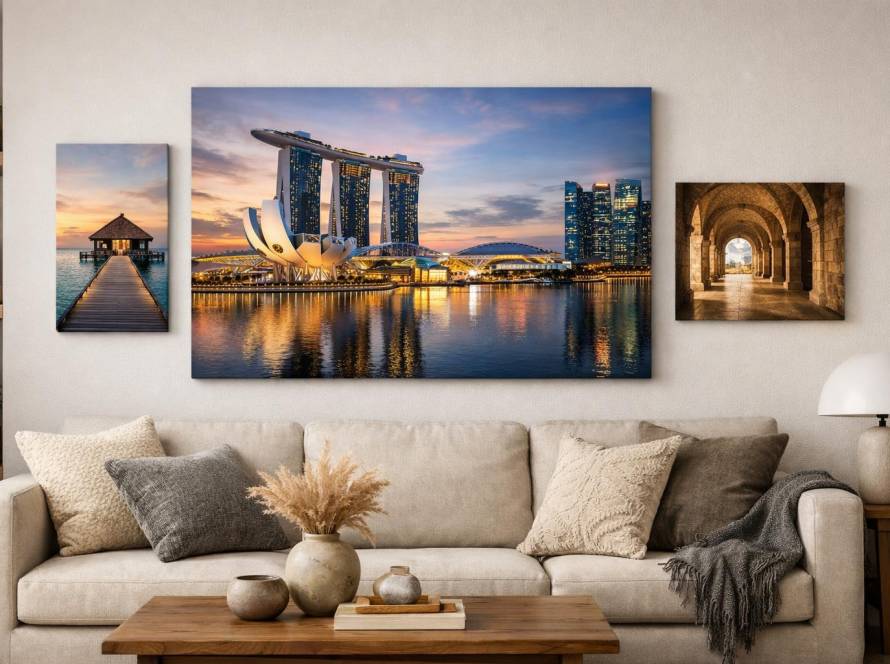
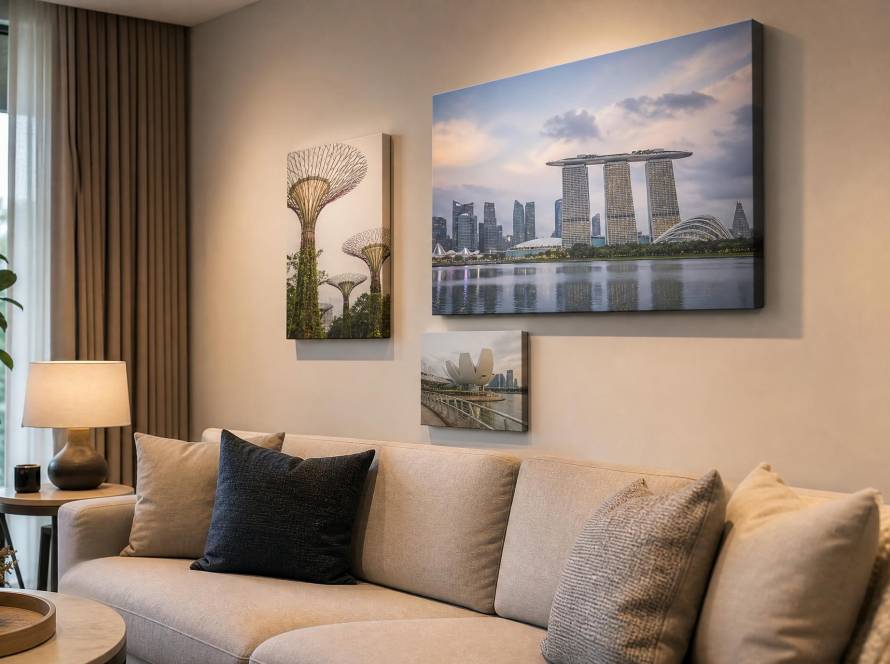
- Salon — mixed sizes placed together in an organic cluster. Pros: informal, flexible, and great for mixing family photos with art. Cons: requires more planning to avoid imbalance.
- Linear — pieces aligned along a common axis (top, bottom, or centre). Pros: clean flow along corridors or above furniture; works well in narrow spaces. Cons: can look repetitive if all pieces are similar.
Choose a layout that matches the walls shape and how people move through the space. A salon style works well above a sofa; a linear arrangement suits narrow corridors; a grid is ideal for wide, uninterrupted walls in living rooms.
Measuring and mapping – paper templates and ledgers
Before drilling any holes, map the composition. Using paper templates and a ledger method will save patching and re-hanging later.
- Measure each artwork: width, height and the distance from the top edge to the hanging point (D from top to hanger).
- Cut kraft paper or newspaper to the exact size of each frame/canvas. Label each template on the back so you know which piece it represents.
- Decide on spacing between pieces—25 cm is common for compact Singapore walls; wider living-room arrangements can use 510 cm spacing. Keep spacing consistent across the display.
- Use painters tape to attach templates to the wall. Begin by placing the centrepiece: measure the recommended eye-level centre (about 145160 cm from the floor is a useful range) or align the composition visually with furniture (e.g., keep the lower edge 1015 cm above a sofa back).
- Step back and view from typical sightlines (seated on the sofa, standing at the dining area, entering the room). Adjust templates until the composition reads balanced from those positions.
- Mark the exact nail positions on the paper templates; transfer those marks to the wall with a pencil. Remove templates and prepare hardware.
Tip: lay your arrangement out on the floor first if wall space is limited. This gives you a clear sense of scale before moving pieces up.
Balancing large and small canvases for visual rhythm
A successful mixed-size gallery wall has rhythm: large pieces anchor, medium pieces connect, and small pieces add detail. Follow these practical approaches:
- Start with an anchor: place one large canvas or framed work where you want the viewers eye to settle first. This is often slightly off-centre rather than dead-centre for a dynamic composition.
- Create visual pathways: use medium prints to lead the eye from the anchor to the edges. Repeat a colour or motif to create links across the cluster.
- Use odd numbers: groups of three, five or seven pieces often feel more natural than even-numbered sets.
- Edge alignment: for a cleaner look, align either the top edges or centres of several works. For a relaxed salon feel, allow edges to float freely but balance the mass with spacing and colour.
- Negative space: dont be afraid of breathing room. Small gaps can highlight individual works and prevent the wall from feeling busy in compact flats.
When mixing canvases and frames, keep at least one consistent element (same frame finish, same border size, or shared colour palette) so the display reads as a single composition.
Hanging hardware and level-check tips
Select hardware appropriate to both your wall type and the artwork weight. Singapore flats can have a variety of wall constructions (plaster over concrete, partition walls, etc.), so check the wall before choosing a fix.
- Lightweight pieces: removable adhesive hooks (e.g., Command strips) can work well in rental situations—check the weight rating and follow the instructions exactly.
- Medium to heavy pieces: use picture hooks rated for the weight, or anchors/rawl plugs for masonry or concrete. For hollow partition walls, use toggle bolts or specialised hollow-wall anchors.
- Large canvases and frames: consider two hangers spaced apart to prevent rotation and reduce stress on the fixings.
- Tools to have: tape measure, pencil, spirit level or laser level, hammer, drill with masonry bit (for concrete), and a stud finder if you want to secure into a stud or joist.
Level-check tips:
- Use a laser level or a long spirit level to mark a straight reference line for tops, bottoms or centres of the composition.
- When using two hooks, measure distances carefully and double-check with the level before drilling.
- After hanging, stand back and view from several sightlines and heights, then fine-tune by lightly adjusting the wires or hooks.
If you prefer professional hanging, many studios and local handymen offer wall-hanging services that consider wall construction and building regulations.
Maintenance considerations for high-traffic zones
Gallery walls in open-plan homes can be exposed to cooking steam, humidity and accidental bumps. Heres how to reduce wear and keep prints looking their best in Singapores climate:
- Humidity: avoid placing canvas prints directly above a cooker or where steam regularly reaches the wall. For kitchens and areas with occasional steam, choose canvases with moisture-resistant coatings and ensure frames have sealed backing.
- Sunlight: prolonged direct sun can fade some prints. If a wall receives strong afternoon sun, consider UV-protective coatings, UV-filtering glass for framed prints, or placing the gallery away from the strongest light.
- Cleaning: dust canvases and frames with a soft microfiber cloth or a very soft brush. For stubborn marks, follow the print makers care instructions—avoid household cleaners or solvents.
- Humidity control: if your flat is particularly humid, silica gel packets inside framed pieces or a dehumidifier in the room helps prevent mould and warping.
- Security: in high-traffic households with children or pets, mount lower pieces out of reach or secure frames with museum putty to prevent accidental tipping.
Canvas Craft prints are made for Singapore homes and you can ask about protective coatings and custom sizes to suit your layout and climate needs. When choosing materials, consider how the artwork will be used and how much handling it will receive.
Final checklist before you drill
- Confirm final layout with paper templates and measurements from multiple sightlines.
- Check wall type and select appropriate anchors or removable fixings for rented properties.
- Choose consistent spacing (25 cm for compact displays) and mark hang points clearly on templates.
- Have a spirit level and at least one assistant to help hold larger pieces while you secure them.
- Consider professional hanging if your wall is masonry and the artwork is heavy.
FAQ
Q: What height should I hang the centre of my gallery wall?
A: Aim for the centre of the overall composition to be between about 145160 cm from the floor. In rooms where people mainly sit (like living rooms), you may want the centre a bit lower; for standing-view areas such as corridors, a bit higher is fine. Use the rooms sightlines as your guide.
Q: How much space should I leave between frames and canvases?
A: For compact Singapore walls, 25 cm spacing keeps the arrangement feeling tight and intentional. Larger living-wall installations often use 510 cm gaps. Keep spacing consistent to maintain balance.
Q: Can I hang heavy canvases on HDB walls?
A: Many HDB walls are finished plaster over solid backing. Use appropriate masonry anchors or consult a handyman for drilling. If youre renting or unsure, removable high-strength hooks can be used for lighter pieces; for heavy works, choose fixings rated for the wall material and weight.
Q: How do I protect canvas prints from Singapores humidity?
A: Avoid placing art where steam reaches it regularly, choose moisture-resistant coatings or sealed-framing, and consider a dehumidifier in very humid rooms. Dust regularly and keep frames sealed where possible to reduce moisture ingress.
Q: Where can I see sizing and framing options for planning my wall?
A: For inspiration and practical sizing options, check gallery examples and sizes & prices information from your chosen print studio. Canvas Craft also offers a range of canvas sizes and finish options to help you plan a layout that fits your home.


1 Comment
Kendra652
Share your link and rake in rewards—join our affiliate team!