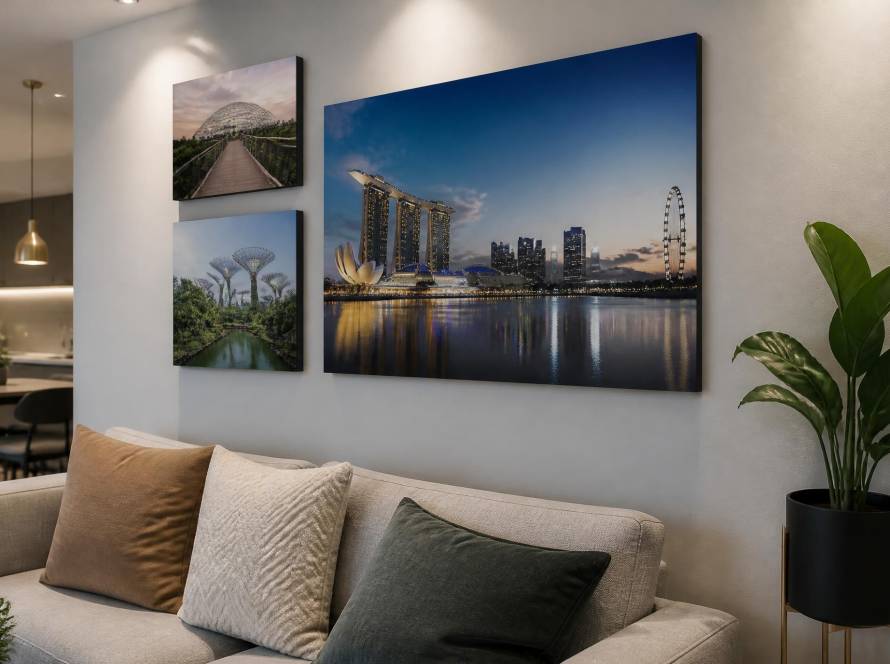
Design rules for choosing large-format canvases that make a statement on typical Singapore condo living room feature walls
Large canvas art transforms a plain condo feature wall into a focal point, but getting the right scale is essential. This guide walks you through practical, repeatable rules for selecting feature wall canvas sizes in Singapore — taking into account wall proportions, ceiling height, recessed lighting, materials, transport constraints and more. Whether you’re a homeowner, buying a gift for a new flat, or a casual photographer printing a standout piece, these tips will help you avoid common sizing mistakes.
Understanding condo feature wall dimensions and focal points
Start by measuring the wall and identifying the focal area. In many Singapore homes — HDB, BTO and condominium living rooms alike — the “feature wall” is the stretch directly above or behind a sofa, TV console or built-in cabinetry. Measure the usable wall width and height, and note any architectural interruptions: windows, aircon ledges, sliding doors, or recessed lighting rails.
Practical measuring checklist:
- Wall width (left to right) and usable height (floor or furniture top to ceiling).
- Distance from top of furniture (e.g. sofa back or console) to ceiling.
- Location of light switch panels, power sockets and wall brackets.
- Doorway, lift and corridor widths you’ll need to pass through for delivery.
Proportion rules: canvas-to-wall coverage percentages
Use coverage percentages rather than fixed sizes. Percentages adapt to different wall widths and help maintain balance across small and large walls.
- Primary single canvas on a feature wall: Aim for the canvas width to be 60–75% of the usable wall width (or of the furniture width if mounted above furniture). This range creates a strong focal point without crowding the wall.
- Single canvas above a sofa: The canvas should be about 60–75% of the sofa width. For example, a 180 cm sofa pairs well with a 110–135 cm wide canvas.
- Gallery wall: For multi-panel or gallery arrangements, let the combined artwork occupy 70–90% of the focal width. Individual pieces are smaller but the overall grouping reads as one statement.
- Floating canvas with negative space: If the goal is minimalism and breathing room, use 40–50% coverage and allow generous margins around the canvas.
When to choose one large canvas vs a gallery wall
Choose a single large canvas when you want a bold, cohesive image or a strong colour statement. Large singular images work particularly well for landscape panoramas, architectural photography and abstract work with strong forms.
Choose a gallery wall when:
- You want to tell a visual story with multiple images (e.g. family photos, travel series).
- You need flexible scale — smaller panels are easier to transport and hang in tight corridors common in Singapore flats.
- Your feature wall is very wide and a single piece would feel monotonous — multiple pieces can create rhythm.
Hybrid approach: centrally place one large canvas and flank it with smaller complementary pieces to get both impact and variety.
Considerations for ceiling height and recessed lighting
Ceiling height affects perceived scale. Many modern condos and flats have low-to-average ceiling heights, so height-conscious scaling matters.
- Low ceilings: Avoid tall, narrow canvases that emphasize vertical height and make the ceiling feel lower. Prefer wider, shallower proportions that sit comfortably above furniture.
- High ceilings: You can introduce taller canvases or stacked arrangements to fill vertical space, but maintain the horizontal proportions recommended above so the piece still reads as a centrepiece.
- Recessed lighting and spotlights: When planning a large canvas, note the position and beam angle of downlights. A canvas directly under a harsh recessed light can glare or highlight texture unevenly. If possible, centre the canvas between lights or use adjustable accent lighting to control reflection.
Material and edge options for oversized canvases
Material choices affect finish, durability and how the piece handles Singapore’s humid climate.
- Canvas types: Cotton and polyester canvases are common. Polyester tends to hold colour well and resists humidity-related expansion more than some natural fibres.
- Print protection: A UV-resistant varnish or laminate protects pigments from sunlight and makes cleaning easier — helpful in bright living rooms.
- Edge options: Gallery wrap (image extends around the sides), mirrored wrap (image continues reversed on the sides), or solid-colour edges (black/white) each change the visual weight of a piece. Deep (30–45 mm) stretcher bars look contemporary and feel substantial; shallow bars are lighter and sit closer to the wall.
- Framing: Float frames add a slim border and protect edges during transport. For very large canvases, consider a discrete frame that makes handling and hanging simpler.
Transport and installation constraints in Singapore condos
Transport and installation are real constraints in high-density housing. Consider doorway widths, lift and stair access, corridor turns, and estate rules.
- Measure all passage points: front door, service lift, lift lobby, corridors and stairwells. Note any tight turns or low beams.
- If a canvas is too wide to pass through doors or lift openings, it may still fit at an angle — but that depends on the overall dimensions. When in doubt, plan for a multipart gallery wall or split the image into panels (diptych/triptych).
- Check condo management rules about delivery times and use of service lifts. Many condominiums require advance booking for large deliveries.
- Installation: consider hiring professionals for very large canvases. Large stretched canvases can be heavy and awkward — installation in Singapore typically requires two people and careful alignment to avoid wall damage.
Canvas Craft can advise on whether a single wrap or a multi-panel solution will travel and install more easily in your block — especially if access is tight.
Example size templates with furniture anchors
Use these templates as starting points. Always measure your space first and apply the percentage rules above.
- Small living area with a narrow sofa (120–150 cm): Canvas width ~70–110 cm (60–75% of sofa width). Good proportions: 70×50 cm, 90×60 cm.
- Standard condo sofa (160–200 cm): Canvas width ~100–150 cm. Good proportions: 100×70 cm, 120×80 cm, 140×90 cm.
- Large sofa or open plan wall (220–300 cm): Canvas width ~140–220 cm. Options: 160×100 cm, 180×120 cm, 200×130 cm. Consider triptychs or a single panoramic print for very wide walls.
- Above a TV console: Aim for the artwork width to be 60–75% of the console width, positioned so the centre of the artwork sits at eye level when seated (roughly 120–140 cm from floor, depending on the household).
Spacing recommendations for gallery walls: leave about 8–12 cm between frames for a tight cohesive look, or 12–20 cm for a more relaxed arrangement.
Ordering checklist for oversized canvas prints
Before you confirm an order, run through this checklist:
- Confirm the wall’s usable width and height and any obstructions.
- Decide the desired coverage percentage (see proportion rules).
- Check passage dimensions: front door, service lift, corridors and staircases.
- Choose material (polyester or cotton), edge depth and protective finishes.
- Consider a multi-panel option if transport or doorway width is a concern.
- Plan hanging hardware and whether you need professional installation.
- Account for humidity protection: choose varnish or laminate and avoid hanging directly opposite wet areas like open windows or bathrooms.
- For gifts (housewarming, wedding, baby announcements): allow extra lead time for custom sizing and framing, and check delivery/installation availability.
Canvas Craft has experience helping customers size and finish large canvases for local homes and can provide guidance if you’re unsure about access or finishes.
FAQ
How high should I hang a large canvas above my sofa?
Aim to have the bottom of the canvas about 15–25 cm above the sofa back. If you prefer the artwork closer to eye level, ensure the centre of the artwork is roughly at seated eye height (commonly around 120–140 cm from the floor, depending on sofa height).
My corridor/lift is narrow — can I still get a large canvas into my flat?
Possibly. Large canvases can sometimes be manoeuvred through at an angle, or you can split the image into panels (diptych/triptych) that are easier to transport and hang. Measure all passageways and discuss options with your printer before ordering.
What finish should I choose for Singapore’s humid climate?
Choose a UV-resistant varnish or laminate and a stable polyester canvas if humidity is a concern. Also keep artwork away from direct sunlight and wet areas. A moisture-resistant backing and good framing practice will extend the life of your print.
Can I frame a gallery-wrapped canvas?
Yes. Float frames are popular because they protect the canvas edge while maintaining a contemporary look. They also make handling and installation easier for large pieces.
How long does a customised oversized canvas take to make and install?
Lead time varies by size, finish and current workload. For oversized or multi-panel orders, allow extra production and installation time. Check with your printer for an accurate estimate and inquire about installation services.
If you’re planning a feature-wall canvas and want tailored advice for your space, reach out to your printer early with measurements and photos — it makes finalising sizes and logistics much smoother.