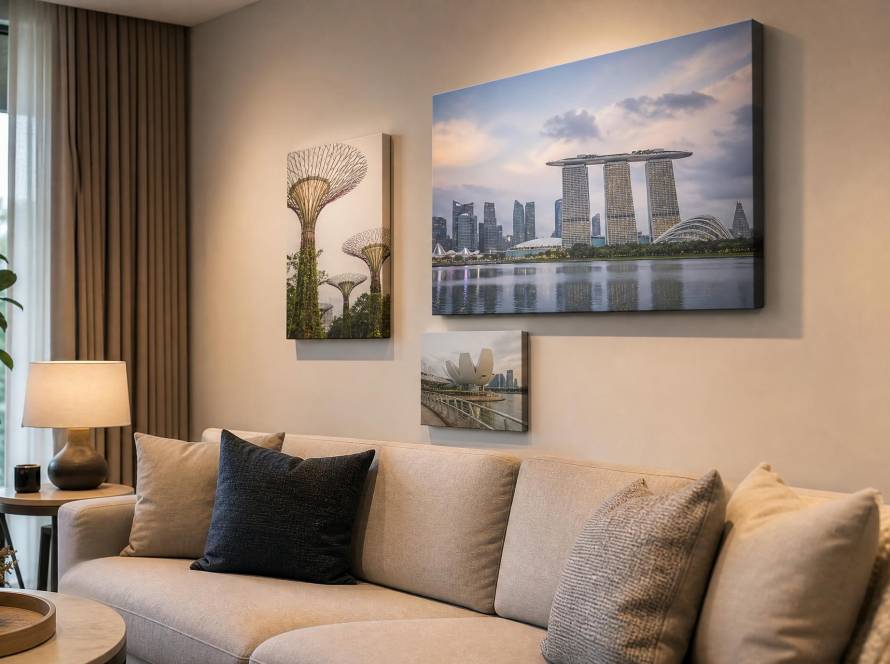
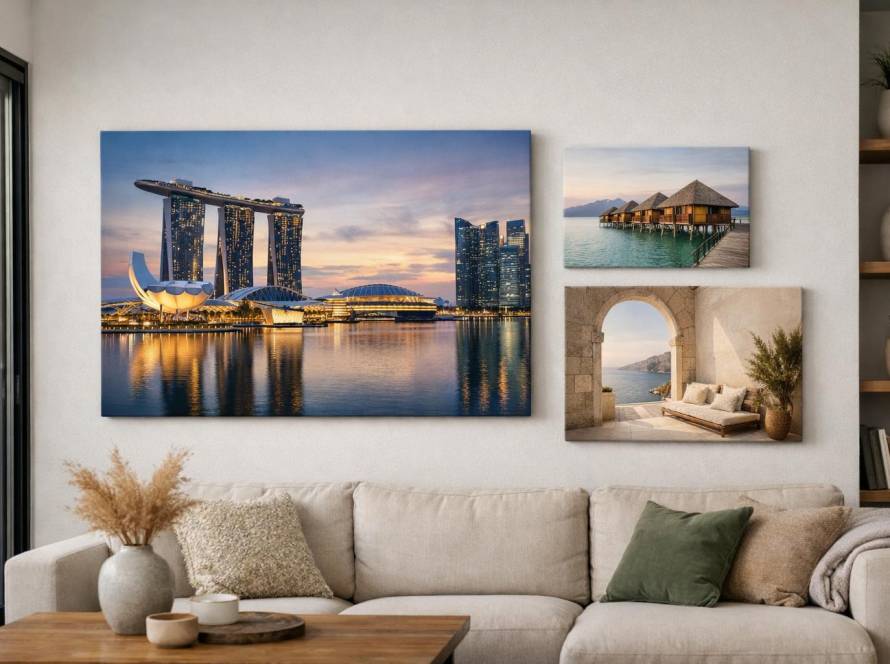
Natural light transforms a home. In Singapore’s HDB flats—where space is often compact and windows may face neighboring blocks—getting the most out of available daylight matters. Strategic canvas wall art arrangements can help bounce, soften, and distribute light more evenly across a room. Here’s how to approach it without guesswork.
Why Natural Light Matters in HDB Living Spaces
Good lighting affects how a room feels. In HDB flats, natural light can make a space appear larger, improve mood, and even reduce reliance on artificial lighting during the day. But not every flat enjoys direct sunlight. Many living rooms and bedrooms in Singapore’s public housing receive side light or filtered light through windows with partial shade. Canvas art, when chosen and arranged with care, can redirect and amplify that light.
Light as a Design Tool
Light interacts with surfaces. A matte canvas absorbs some light; a glossy finish reflects it. White or pale walls already do some of the work, but adding a well-placed canvas with the right finish can create subtle shifts in brightness. In a typical four-room HDB flat, the living room often serves as the daylight core. Arranging canvases opposite or adjacent to windows can pull light deeper into the room.
Choosing Canvas Prints to Reflect and Amplify Light
Not all canvases behave the same under daylight. The substrate, finish, and even the image content influence how light travels around the room.
Matte vs. Glossy Finishes
Matte finishes reduce glare, which is helpful in rooms with direct sunlight. Glossy finishes, on the other hand, create small reflections that can lift a darker corner. For HDB flats where windows are north- or south-facing (common in newer BTOs), glossy canvases can help distribute soft light without harsh hotspots. In east- or west-facing rooms, matte is often a safer choice to avoid late-afternoon glare.
Subject Matter and Light
Images with high contrast—like a bright sky against dark foliage—can create an illusion of depth. Landscapes with strong light sources (sunsets, open fields) act as secondary windows. Abstracts with metallic or pale washes also work well. Avoid overly dark or busy images if the goal is light distribution; they tend to absorb rather than reflect.
Arranging Canvas Art for Optimal Light Distribution
The way you group and position canvases matters as much as the prints themselves. In HDB flats, walls are rarely vast, so precision matters.
Single Large Piece vs. Gallery Wall
A single large canvas placed opposite a window can act as a light reflector, especially if it has light tones. A gallery wall—multiple smaller canvases—can scatter light patterns. For a typical HDB living room (e.g., 4m x 3.5m), a single 80×120 cm canvas on the main wall opposite the window works well. In narrower corridors or above a sofa, a set of three 30×40 cm canvases spaced 8 cm apart can break up light and reduce shadow pooling.
Placement Relative to Windows
Canvases mounted perpendicular to a window receive side light, which can create interesting shadow effects. Canvases mounted directly across from a window get direct light, enhancing their role as reflectors. Avoid placing large canvases directly beside a window if the flush is deep—this can create a dark block that interrupts light flow.
One practical tip: before drilling, tape a sheet of paper the same size as your planned canvas to the wall and observe how light falls on it at different hours over a weekend. This simple test costs nothing and saves guesswork.
Color Schemes and Their Interaction with Light
Color temperature and saturation affect how a canvas reads in changing light. In Singapore’s tropical daylight—which is often warm and diffuse—certain tones amplify light better than others.
Cool vs. Warm Tones
Cool tones (soft blues, greys, whites) tend to recede, making a wall feel farther away. Warm tones (pale yellows, blushed pinks) advance and can make a room feel cozier but may absorb more light. For HDB flats with limited natural light, a mix of cool and warm in a single canvas can balance reflection and warmth. For example, a canvas with a pale blue sky and warm sand tones provides both depth and soft glow.
Metallic and Iridescent Accents
Some canvas prints incorporate metallic leaf or iridescent pigments. These catch light from different angles, creating subtle shifts throughout the day. Use them sparingly—one or two in a group arrangement—to avoid visual clutter. Canvas Craft offers options with metallic finishes in some collection prints, which are worth considering for a feature wall near a light source.
Case Studies: Transforming HDB Flats with Canvas Art
Case Study 1: Four-Room BTO in Punggol
A couple with a north-facing living room wanted to brighten their space without repainting. They chose three 40×60 cm canvases with pale seascapes and arranged them in a vertical line on the wall adjacent to the window. The matte finish reduced glare, and the light blues and whites reflected ambient daylight into the dining area. The result: the room felt 20% brighter by their own measurement, without any structural changes.
Case Study 2: Three-Room Resale Flat in Toa Payoh
An older flat with small windows and a dark corridor needed a lift. The owner installed a single 60×90 cm canvas with an abstract gold-and-white design on the wall at the end of the hallway, opposite a small window. The metallic accents caught even minimal light, creating a bright focal point that visually shortened the corridor. The owner later added a second canvas near the living room window to create a light echo effect.
Professional Installation Tips for HDB Walls
HDB walls are typically concrete or brick with a layer of plaster. Here’s how to install canvases safely and effectively.
Mounting Hardware
Use wall plugs and screws rated for at least 5 kg per point. For heavier canvases (above 1m width), use two hanging points. Avoid adhesive strips for anything larger than 30×40 cm—Singapore’s humidity can weaken their grip over time.
Spacing and Height
In HDB flats, ceiling height is usually around 2.6 to 2.8 m. Center your canvas at eye level (145–150 cm from the floor to the centre of the piece). For gallery walls, maintain 8–10 cm gaps between frames. Consistent spacing helps light travel evenly rather than hitting sudden dark gaps.
Humidity Considerations
Singapore’s humidity can cause canvas to warp or paper prints to bubble. Choose stretched canvases with a solid wooden frame and a UV-protective coating. Check our sizing and pricing page for options that suit your wall dimensions. If the room is prone to moisture (e.g., near a kitchen or bathroom), consider placing canvases at least 50 cm away from potential steam sources.
Frequently Asked Questions
1. Can canvas art really make a room brighter?
Yes, if the canvas has light-reflecting qualities—pale colours, glossy or metallic finishes, and high-contrast imagery. It won’t replace a window, but it can help distribute existing light and reduce shadow zones.
2. What size canvas works best in an HDB living room?
For a standard 4m x 3.5m living room, a single canvas of 80×100 cm or 90×120 cm is a common choice. For gallery walls, sets of three 30×40 cm or 40×60 cm canvases spaced 8–10 cm apart work well.
3. Will humidity damage my canvas?
With proper care—stretched canvas, wood frame, and UV-protective coating—canvas can last years in Singapore’s climate. Avoid hanging near air-conditioner vents or bathroom doors. Dust gently with a dry cloth every few weeks.
4. Should I choose matte or glossy for an east-facing room?
Matte is generally better for east-facing rooms to reduce morning glare. Glossy works well in north- or south-facing rooms where light is softer and more diffuse.
5. Can I arrange canvases myself, or should I hire a pro?
Many homeowners arrange their own canvases using painter’s tape and a level. For heavy or large pieces (above 1m width), professional installation is safer. Canvas Craft offers guidance on arrangement and can point you to installers if needed.