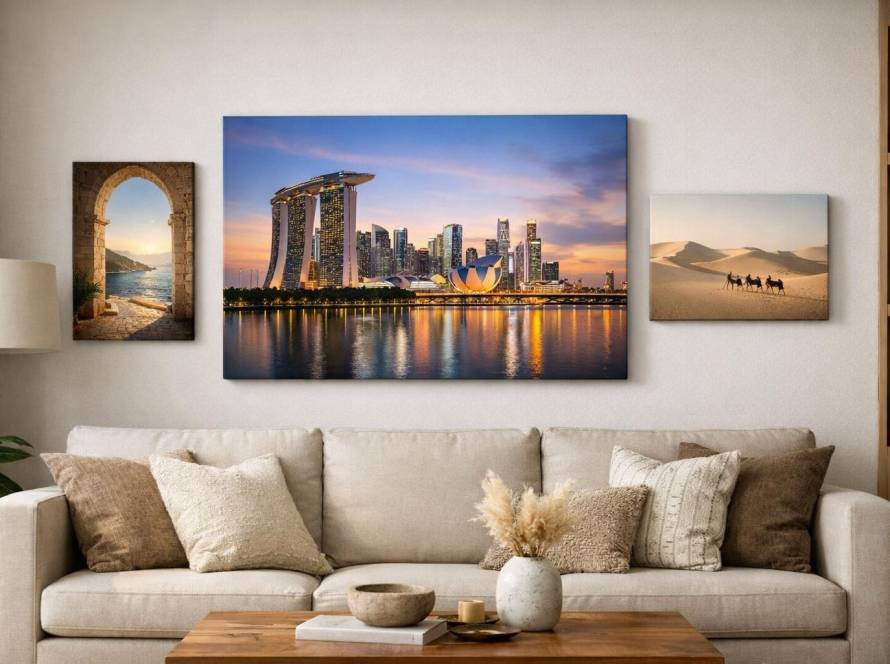
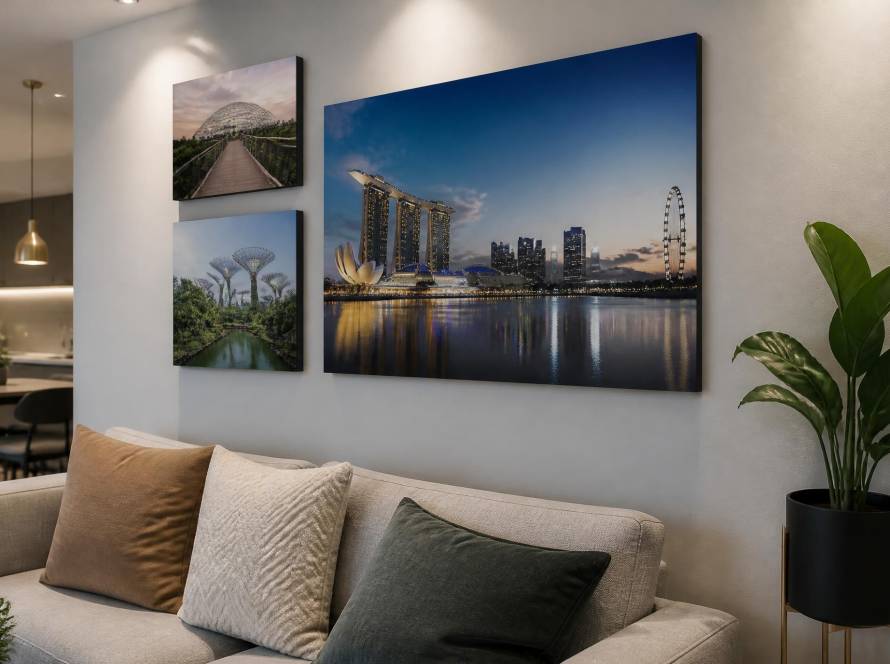
Narrow HDB corridors are a common feature in many Singapore flats, especially in older BTO layouts and resale units. While they serve a functional purpose—connecting rooms and providing storage—they often feel tight, especially when wall decor is added. The wrong canvas size can make the passageway feel smaller, while the right choice can open it up visually and add personality.
This guide helps Singapore homeowners, gift buyers, and casual photographers choose canvas print sizes that fit narrow HDB corridors without making the space feel cluttered. We’ll cover measuring your corridor, orientation, mounting height, and the hardware that works best for HDB walls.
Measuring corridor width and sightlines in HDB layouts
Before choosing any canvas, take a few minutes to measure your corridor. In most Singapore HDB flats, corridor widths range from 90 cm to 110 cm (about 3 to 3.6 feet). In some older units it can be narrower, around 80 cm. You’ll also want to consider the direction people walk.
What to measure:
- Clear width: Measure the distance between the two walls. That’s your total available space.
- Wall space: If your corridor has doors or windows on one side, measure the length of uninterrupted wall where you plan to hang the canvas.
- Sightline: Stand at the entrance of the corridor and look straight down. If the canvas is placed near the end, it should be clearly visible but not overwhelming.
For a typical HDB corridor width of 100 cm (about 39 inches), a canvas wider than 50 cm (about 20 inches) will start to feel large. The general rule: keep the canvas width to no more than 40–50% of the corridor width. That leaves enough breathing room on each side and doesn’t force people to walk too close to the wall.
Recommended maximum canvas widths based on corridor dimensions
Use this quick reference for your HDB corridor:
- Corridor 80 cm wide (narrower resale flats): Max canvas width ~30 cm (12 inches).
- Corridor 90–95 cm wide (common in 3-room BTOs): Max canvas width ~38 cm (15 inches).
- Corridor 100–110 cm wide (standard in 4-room/5-room flats): Max canvas width 45–50 cm (18–20 inches).
These are not rigid rules, but practical guidelines. If you choose a wider canvas, consider a thinner frame (such as gallery-wrapped canvas without an external frame) to minimize the visual bulk.
Orientation choices: portrait vs landscape for flow
Orientation affects how the corridor feels to walk through.
Portrait (vertical) orientation is generally the better choice for narrow corridors. It draws the eye upward, making the ceiling feel higher and the space less confined. A portrait canvas also fits well on a wall that’s limited in width but has reasonable height (most HDB corridors have ceiling heights around 2.6 to 2.8 metres).
Landscape (horizontal) orientation can work if the corridor is on the wider side (100 cm+), but be careful. A wide landscape canvas can visually widen the corridor, but if it’s too large it may look like it’s crowding the walls. Use landscape only if you have at least 10–15 cm of wall space on both sides of the canvas.
A good middle ground is a square canvas (e.g. 40×40 cm or 50×50 cm). It offers a balanced look without forcing the eye too far to either side.
Best mounting heights to avoid headspace conflicts
In a narrow corridor, people often walk close to the wall. If the canvas is hung too low, it risks getting bumped by shoulders or bags. Too high, and it becomes hard to see.
Standard recommendation for corridors:
- The centre of the canvas should be at eye level for an average height adult (about 150–155 cm from the floor). This is slightly lower than the usual 160 cm for living rooms because people are usually standing and walking in the corridor.
- If you have children or taller household members, adjust by ±5 cm. The key is that the canvas is not in the direct path of a shoulder.
- For a portrait canvas, the bottom edge should be at least 140 cm from the floor to avoid being bumped.
Also consider the ceiling height. In some HDB corridors with false ceilings or light tracks, you may need to mount the canvas lower than usual. Always use a spirit level and measure twice before drilling.
Creating rhythm with a series of small canvases
A single large canvas isn’t the only option. In fact, a series of smaller canvases (two or three) can create a more dynamic display in a long passageway. This works especially well if the corridor is narrow but long (say, 3–4 metres).
How to arrange them:
- Use canvases of the same size or a consistent theme (e.g., all black-and-white photography, or all botanical prints).
- Space them evenly, typically 8–12 cm apart. This creates a rhythm that leads the eye down the corridor.
- Keep the group’s total width to about half of your corridor width to avoid clutter. For a 100 cm corridor, a row of three 25 cm wide canvases with 10 cm gaps would total ~95 cm – that’s fine, but for a tighter corridor, opt for two small pieces instead.
A gallery wall is possible but requires careful planning. For most narrow corridors, a linear arrangement (single row) is safer than a grid or cluster, which can feel busy.
Materials and edge finishing to minimise protrusion
When wall space is tight, every centimetre of depth counts. Standard canvas prints with a thick stretcher bar and external frame can protrude 4–6 cm from the wall. That might not sound like much, but it can feel closer to you in a narrow corridor.
Choose these instead:
- Gallery-wrap canvas without a frame: The canvas wraps around the sides, so the depth is only about 2–3 cm. This keeps the print flush to the wall and reduces the risk of accidental knocks.
- Floating frame or thin edge profile: Some canvas finishes have a very slim edge (1.5 cm). These look modern and are excellent for corridors.
- Mirror edge or wrap: If you want the image to continue on the sides, a full wrap is a neat solution that doesn’t add bulk.
At Canvas Craft, we offer a range of edge finishing options. You can view examples in our gallery to see how different depths look on actual walls. For narrow spaces, the slim gallery-wrap style is the most practical.
Low-profile hanging systems suited for HDB walls
HDB walls are typically built with hollow bricks or reinforced concrete. Drilling into them requires care, especially in corridors where you might have limited space to work.
Recommended hanging methods:
- Picture rails with wire: A low‑profile rail system sits near the ceiling and uses thin wires to hold the canvas. This keeps the canvas close to the wall and allows easy repositioning. It’s ideal for renters too, because you only drill once for the rail.
- Offset clips or sawtooth hangers: These attach directly to the back of the canvas and require a single small nail or screw. They keep the canvas very close to the wall (within 1–2 cm).
- Adhesive strips (for lightweight canvases under 2 kg): Some high‑quality adhesive strips can hold a small canvas on HDB painted walls. But avoid this for heavy or framed pieces—they can fall over time, especially in high‑humidity Singapore.
Whichever system you choose, ensure that the hanging point is centred and strong enough to hold the weight. If you’re unsure, it’s worth getting a handyman or using the advice page on our website – check our FAQ for more tips on wall mounting.
Frequently Asked Questions
What is the best canvas size for a 90 cm wide HDB corridor?
For a 90 cm wide corridor, a canvas width of about 35–38 cm (14–15 inches) works well. That gives you roughly 25 cm of free space on each side. A portrait or square orientation is recommended.
Can I use a large canvas in a narrow corridor if I use a thin frame?
Yes, but limit the width to 45–50 cm if your corridor is 100 cm or wider. Ensure the frame depth is under 3 cm to minimise protrusion. A gallery‑wrap without an external frame is the best choice for a large canvas in a tight space.
Should I hang the canvas before or after moving furniture into the corridor?
It’s better to hang the canvas after furniture (like a console or shoe cabinet) is in place. This gives you a realistic sense of the remaining wall space and sightlines. Also measure from the floor to the canvas, not from the ceiling, to avoid conflicts with furniture.
How do I protect the canvas in a high‑humidity corridor (e.g., near the kitchen or bathroom)?
In Singapore’s humid climate, it’s wise to choose a canvas printed with archival‑quality inks and a protective UV laminate. Avoid placing the canvas directly opposite an air‑conditioning vent or in a spot where steam from the kitchen hits it regularly. A lightweight canvas can be sealed with a spray varnish, but most premium canvas prints are already coated.
If you’re buying a canvas print specifically for a narrow HDB corridor, remember to measure twice and choose a size that leaves room to walk. For more details on sizing, visit our Sizes & Prices page. For custom orders, head to our Order page. At Canvas Craft, we help you get the perfect fit for your space.