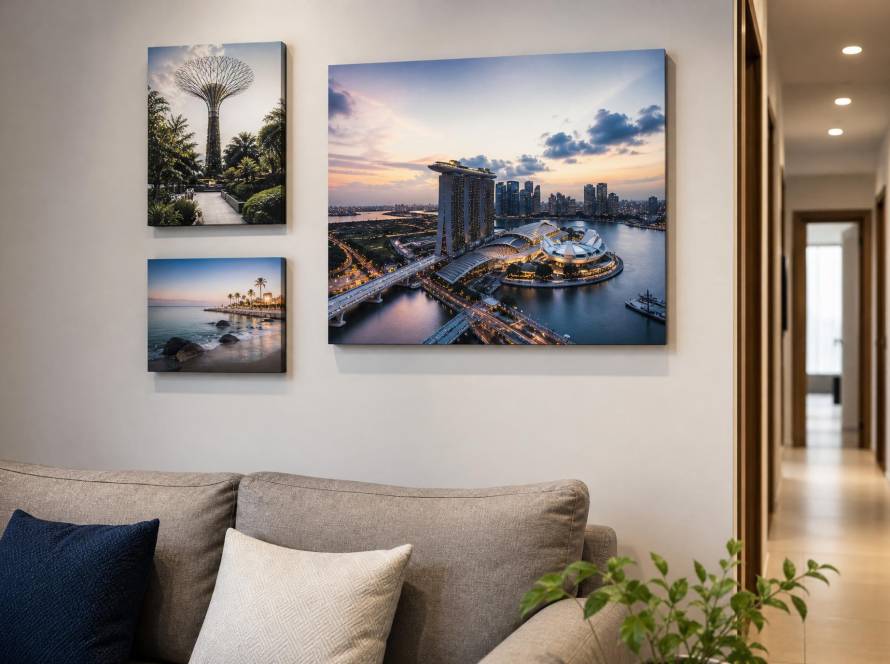
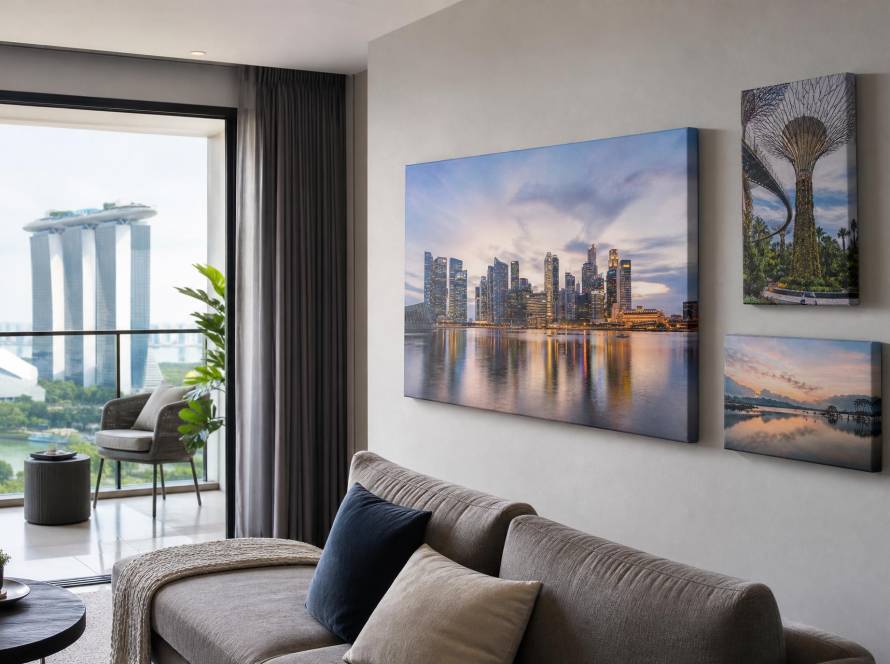
Living in a compact Singapore flat often means making every wall count. A multi-panel canvas wall art gallery can transform a narrow corridor, a small living room, or a study nook into a curated, spacious-feeling space—without the visual clutter of many small frames. This guide covers practical layout options, measurement tips, and hanging techniques so you can plan your gallery with confidence.
Multi-Panel Canvas Wall Art Basics
Before diving into layouts, understand the common panel configurations. Each creates a different rhythm on the wall.
Common Panel Formats
- Diptych – Two panels side by side. Best for a wide but shallow wall (e.g., above a sofa or console table). The split image draws the eye horizontally.
- Triptych – Three panels in a row. A classic choice for corridors or above a dining table. The centre panel typically carries the focal point.
- Modular grid – Four or more equal-sized panels arranged in a symmetric block (e.g., 2×2, 2×3). Works on larger wall areas in open-plan living rooms.
Choose a format that suits your wall dimensions, not the other way around. A triptych that is too wide will overwhelm a narrow HDB corridor.
Measuring and Spacing for Narrow Walls and Corridors
Accurate measurement is the foundation of a clean gallery. In compact Singapore flats, wall space is a premium, so every centimetre counts.
Step 1: Map Your Wall Area
Measure the width and height of the wall you want to cover. Then decide how much breathing room you want around the artwork. A good rule is to leave at least 15–20 cm between the edge of the canvas and the nearest architectural feature (door frame, corner, window).
Step 2: Determine Panel Spacing
For multi-panel installations, consistent spacing between panels is key. The standard gap is 4–6 cm for small to medium canvases (40×60 cm or smaller) and 6–8 cm for larger panels. For a narrow corridor, use a tighter gap (4 cm) to keep the arrangement compact and visually connected.
Step 3: Calculate Total Width
If you are arranging a triptych of three 50 cm-wide panels with 5 cm gaps, the total width is (3 × 50) + (2 × 5) = 160 cm. Make sure this fits comfortably within your measured wall area.
Visual Balance: Focal Panel and Supporting Pieces
Even a grid of identical panels benefits from a subtle focal strategy. With a triptych or diptych, consider these approaches:
- Focal panel approach – In a triptych, make the centre panel slightly larger or more detailed (e.g., a close-up subject while the side panels show the wider scene). This creates a natural hierarchy.
- Even weight – For a modular grid of equal panels, ensure the overall image or colour theme is balanced. Avoid placing all dark panels on one side unless you want a directional emphasis.
- Staggered vs. linear – Staggered layouts (panels offset vertically) suit irregular walls or stairwells. Linear layouts (all panels aligned on the same horizontal axis) are safer for sofa backs and console tables.
Alignment and Level Techniques
A misaligned multi-panel gallery can ruin the effect of a carefully chosen canvas. Here are reliable methods:
- Paper template method – Trace each canvas shape on paper, cut it out, and tape the templates to the wall. Adjust positions until you are satisfied, then mark the hanging points.
- Laser level – Use a laser level to draw a horizontal or vertical reference line. This is especially helpful for linear layouts on long living room walls.
- Spacer tool – Use a piece of cardboard cut to your chosen gap width to maintain consistent spacing as you hang each panel.
- Mark in pairs – For a diptych, hang the first panel, measure the gap, and mark the second panel’s position from the first. Avoid measuring from the floor as floors may not be perfectly level.
Orientation Tips for Low Ceilings and Small Rooms
Many Singapore flats have ceiling heights between 2.6 and 2.8 metres. A low ceiling can feel compressed if the gallery sits too high or too low.
- Eye-level rule – The centre of the gallery should be roughly 145–150 cm from the floor. For a triptych on a corridor wall, this often means the bottom edge of the canvases sits around 100–110 cm off the floor.
- Vertical triptychs – If a wall is tall but narrow (e.g., beside a doorway), arrange three panels vertically instead of horizontally. This draws the eye up and makes the ceiling feel higher.
- Keep it low – In a small room with low furniture (e.g., a console table), place the gallery 15–20 cm above the furniture rather than floating high on the wall.
Previewing Layouts with Digital Mockups or Paper Cutouts
Planning ahead saves drilling unnecessary holes. Try these no-cost preview methods:
- Paper cutouts – As mentioned, tape paper templates to the wall. Walk back 3–4 metres and assess the visual weight.
- Painter’s tape – Outline the exact dimensions of each canvas on the wall. This gives a clear sense of the gallery’s footprint.
- Digital mockup tools – Use a free online tool or even a photo-editing app. Snap a picture of the empty wall, then overlay scaled rectangles to test grids, gaps, and alignment.
Hanging Hardware and Safety Considerations
Canvas prints with a frame or a thick gallery wrap can be heavier than standard posters. In Singapore, where walls may be plasterboard or concrete, choose hardware accordingly.
- Picture hooks – For lightweight canvases (under 2 kg) on plasterboard, use picture hooks with small nails. For heavier pieces, use toggle bolts or molly bolts rated for the weight.
- Concrete walls – Common in HDB flats. Use a masonry drill bit and plastic wall plugs. A cordless drill with a level attachment saves time on multi-panel jobs.
- Safety tip – Avoid hanging heavy multi-panel galleries directly above beds or sofas without secure wall anchors. Consider using two hooks per large canvas for added stability.
- Level final check – After hanging each panel, step back and check alignment. A slight tilt is easier to fix immediately than after all panels are up.
Budget and Sizing Trade-Offs When Ordering Multiple Panels
Ordering multiple canvas panels at once requires balancing size, quantity, and budget.
- Size vs. quantity – A 3-panel triptych of 60×40 cm canvases often costs more than a single large canvas of similar total area. But the multi-panel look can feel more intentional and less dominating in a compact room.
- Standard vs. custom sizes – Stick to standard square or rectangular sizes to keep per-panel costs lower. Custom dimensions may incur a surcharge.
- Order matching – When ordering a set, request that all panels come from the same production batch to ensure colour consistency. Most canvas printing services, including Canvas Craft, can coordinate multi-panel orders if you specify the layout.
- Shipping and handling – Larger panels may be shipped individually. Factor in delivery timelines if you need the gallery installed by a specific date.
If you are a photographer or artist planning to sell multi-panel sets, consider offering pre-coordinated layouts. For more insights on preparing images for print, visit the Canvas Craft For Pros page.
FAQ
What is the ideal gap between canvas panels?
For most Singapore flat spaces, a gap of 4–6 cm works well for small to medium canvases. For larger panels (80 cm wide or more), 6–8 cm looks balanced.
How do I hang a multi-panel canvas on a concrete wall without damaging it?
Use a masonry drill bit and plastic wall plugs rated for the weight of the canvas. For heavier multi-panel sets, consider a wire hanging system or a picture rail.
Can I mix different canvas sizes in one gallery?
Yes, but maintain a consistent bottom alignment or centre line to keep the arrangement cohesive. Staggered layouts also work well for mixed sizes if you keep the total outer shape rectangular.
How do I preview a triptych layout before ordering?
Use painter’s tape to mark the dimensions on your wall, or create paper cutouts. You can also use a free online wall art layout tool or simply sketch the wall to scale.
What file resolution should I use for multi-panel canvases?
For each panel, aim for at least 150–200 DPI at the final print size. If you are printing a single image split across panels, make sure the source file resolution supports the full combined width.
Browse Canvas Craft’s Sizes & Prices page to find panel dimensions that fit your layout, and see the Gallery for inspiration on how other Singapore customers have arranged multi-panel order in compact spaces.