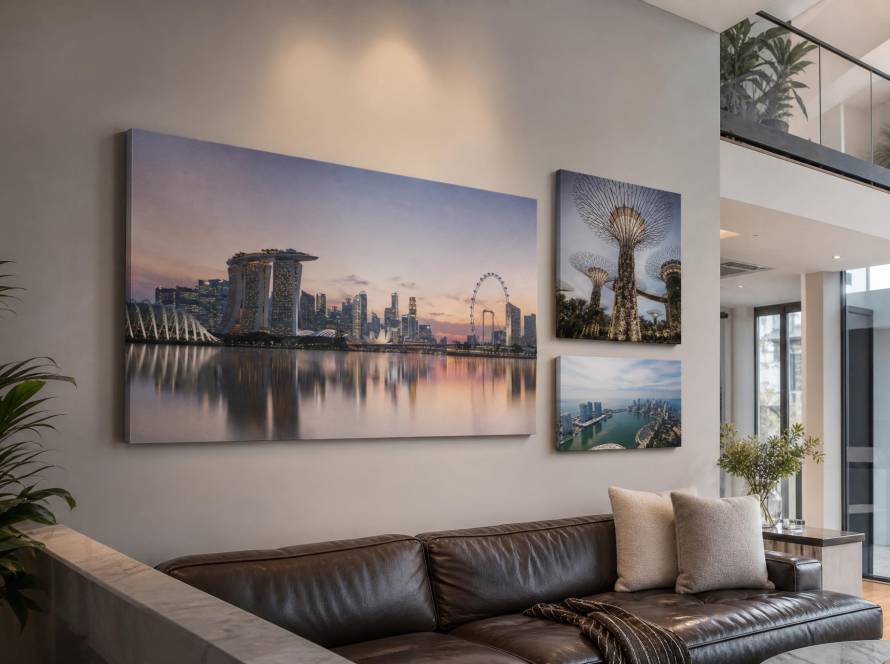
Deciding on the orientation of a canvas print for your balcony might seem like a minor detail, but it can make or break the visual flow of your outdoor space. Whether you’re looking at a narrow HDB balcony, a sprawling condo terrace, or a cosy BTO planter, the way a canvas sits on the wall influences both the perceived size of the area and how you experience the view. In this guide, we’ll walk through the practical considerations of portrait, landscape, and panoramic canvas prints specifically for Singapore balcony vistas, so you can choose with confidence.
Evaluating balcony proportions and guardrail sightlines
Before you fall in love with a particular image, step back and measure your balcony. Most Singapore balconies fall into one of three categories: the compact 2-metre-wide HDB balcony, the medium-sized condo balcony (typically 3 to 4 metres), or the larger terrace or penthouse space. The width of the wall you intend to hang your canvas on is the first filter. A tall, narrow wall naturally suits a portrait orientation; a wide but low wall calls for landscape or panoramic.
Equally important is your guardrail height. The standard balustrade in Singapore is about 1.1 metres. When you’re seated, your eye level is usually around the same height as the guardrail. If you’re hanging a canvas at eye height, consider whether the guardrail blocks the lower part of the artwork when you’re sitting. A portrait canvas can actually complement a guardrail by drawing the eye upward, while a wide landscape may be partially obscured by the railing if placed too low. Always visualise both the standing and seated line of sight before committing.
When portrait works: vertical skyline and palm tree subjects
Portrait orientation—taller than it is wide—works best when your balcony has vertical architectural elements, such as a narrow wall beside a sliding door, or when you want to emphasise height without occupying too much horizontal space. In Singapore, a favourite subject of this orientation is the iconic skyline with a strong vertical axis: think of the Marina Bay Sands silhouette or the Singapore Flyer, where the vertical lines of buildings naturally complement your wall.
Palm trees are another excellent portrait subject. A single swaying palm against a sunset sky captures the tropical spirit of Singapore and fits a tall, narrow space beautifully. Because portraits draw the eye upward, they also make a low-ceiling balcony feel taller—a helpful trick for older HDB flats with standard 2.6-metre ceilings. When you’re choosing a portrait canvas, opt for images with clear vertical lines or a single focal point to match the aspect ratio.
Landscape and panoramic choices for sweeping sea or city views
Landscape orientation (wider than tall) is the default choice for most balcony art, and for good reason. It mimics the natural horizontal field of vision and works well on longer walls. If your balcony faces the sea, a landscape canvas with a wide horizon line can recreate that sense of expanse. Similarly, a cityscape that spans from left to right feels more immersive when presented in landscape.
For truly wide balconies—those that span more than 3 metres—a panoramic format (with an aspect ratio of 2:1 or wider) can create a cinematic effect. Panoramic prints are ideal for showing a continuous skyline, like the downtown view from the East Coast, or a stretch of rolling clouds over the Johor Strait. However, be mindful that panoramic prints require a strong supporting wall or beams. They also need to be mounted at a height where the full width is visible without awkward cropping by furniture or plants.
Balcony furniture placement and canvas sightlines
Your furniture arrangement dictates where the eye lands. If you have a small two-seater bistro set on your balcony, you’ll mostly be looking at the opposite wall while seated. If that wall is partially blocked by a planter or a side table, you need to adjust your canvas height or size. A useful rule of thumb: the centre of the canvas should be at your seated eye level (around 150 cm from the floor) if you plan to view it while sitting. If you primarily stand on the balcony, aim for 160–170 cm.
Also consider how the canvas interacts with the direction of your furniture. If your sofa or lounge chair faces the view, the canvas should complement, not compete, with the actual landscape beyond. A portrait canvas with a palm tree might echo the real tree you see outside, creating a harmonious layering effect. On the other hand, a busy, high-contrast landscape canvas could fight with the moving clouds or passing boats—so keep the subject calm or abstract.
Durability notes for semi-outdoor balcony installations
Singapore’s tropical climate is tough on artwork. High humidity, direct afternoon sun, and occasional rain splash can degrade a standard canvas print in a matter of months. When choosing a canvas for a semi-outdoor balcony, look for three things: UV-resistant inks, archival-grade canvas substrate, and a matte or satin varnish that protects against moisture. At Canvas Craft, our gallery-wrapped canvases come with a protective coating, but we always recommend installing them away from direct spray or prolonged sun exposure.
If your balcony is fully sheltered—like a typical HDB planter with a solid ceiling and half-wall—you have more flexibility. But even then, consider placing the canvas on a wall that receives no direct sunlight between 11am and 3pm. For totally exposed balconies, a more durable option might be a framed print under glass, but that adds reflections. Alternatively, you can treat the canvas with a waterproof spray, but be aware that it may slightly alter the look.
Framing and mounting options to withstand breeze and humidity
Mounting is just as critical as orientation. A light breeze might not topple a small canvas, but a sudden storm gust can. Use stainless steel or wall anchors rated for your balcony’s wall material (concrete, brick, or hollow block). We recommend a two-point hanging system with a locking wire for added stability. For extra protection against humidity, you can add a thin moisture barrier behind the canvas—a simple layer of plastic sheeting—but avoid trapping air between the wall and canvas to prevent mould.
Framing also matters. A traditional wooden frame can warp in high humidity, so look for aluminium or a powder-coated steel frame if you plan to have a floater frame style. At Canvas Craft, we offer a range of framing options, including a slim aluminium frame that resists corrosion. A frame with a slight spacer creates a beautiful shadow gap and keeps the canvas from touching the wall, promoting air circulation.
Sample size recommendations for typical condo balconies
For a standard 2.5-metre-long wall on a typical condo balcony, a landscape canvas of 60cm × 40cm works well as a focal point, while a 90cm × 60cm is bolder. If you prefer portrait, a 50cm × 70cm or 60cm × 90cm suits a wall beside the window. For panoramic prints, upsizing to 120cm × 50cm or 150cm × 60cm is possible if the wall is clear and you have adequate mounting support. Always measure your wall width first—leave at least 15cm of breathing space on either side of the canvas.
For HDB balconies that are narrower, you might want to stick with a portrait 40cm × 60cm or a small landscape 60cm × 40cm. If you’re planning a set of three canvases, consider a triptych with each piece in portrait orientation arranged horizontally. For a more precise reference, visit our sizes and prices page to see the available dimensions and get a quote based on your chosen photo.
Frequently asked questions
Can I hang any canvas on a fully exposed balcony?
We recommend against hanging a standard canvas on a fully exposed balcony—think rain, splashing, and harsh UV rays. If you have no alternative, use a waterproof UV-resistant canvas and install it under a deep overhang. Expect to replace it sooner than an indoor canvas. For truly exposed areas, consider a metal or acrylic print instead.
What aspect ratio should I use for a panoramic balcony canvas?
For a true panoramic feel, aim for an aspect ratio of at least 2:1, such as 80cm × 40cm or 120cm × 50cm. This gives you that cinematic width. But double-check your wall space—panoramics require a long, uninterrupted wall to work effectively.
How high should I mount a canvas on a balcony?
For seated viewing, centre the canvas at about 150 cm from the floor. For standing, place the centre at 160–170 cm. Adjust if you have unusual furniture heights. Always keep the canvas at least 150 cm away from any direct water source.
Can I use a canvas to make a small balcony look bigger?
Yes. A landscape canvas with a deep perspective—such as a road leading to the sea—can create depth. Place it on the longest wall to elongate the space. Avoid large, busy images that might overwhelm the area.
Are there gifting occasions where canvas prints for balconies are popular?
Definitely. Housewarming gifts for friends who just collected their BTO keys, or wedding gifts for couples moving into a new condo, are prime occasions. A personalised canvas of their favourite view or a stylised print of Singapore’s skyline makes a thoughtful, durable gift that suits the balcony setting.