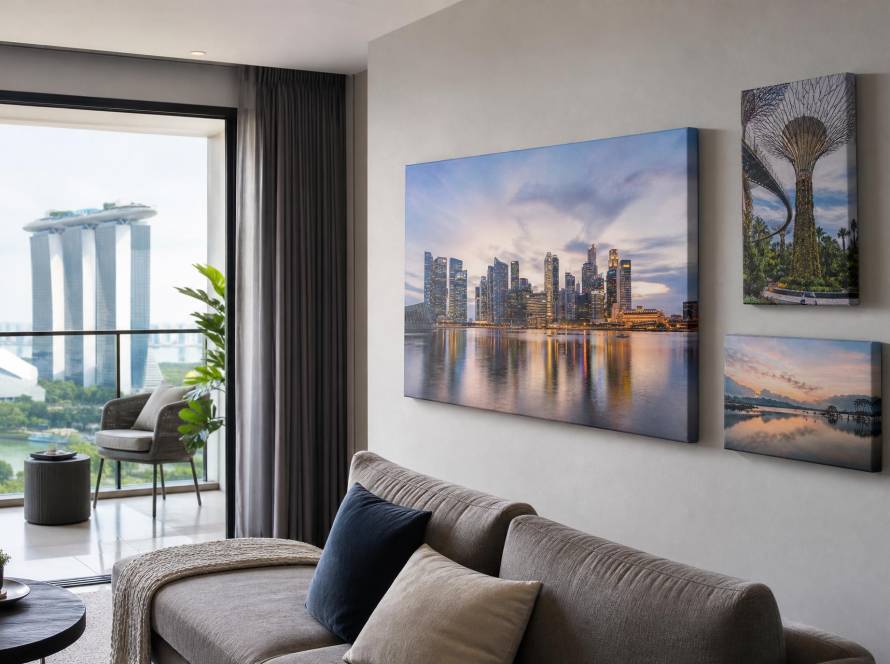
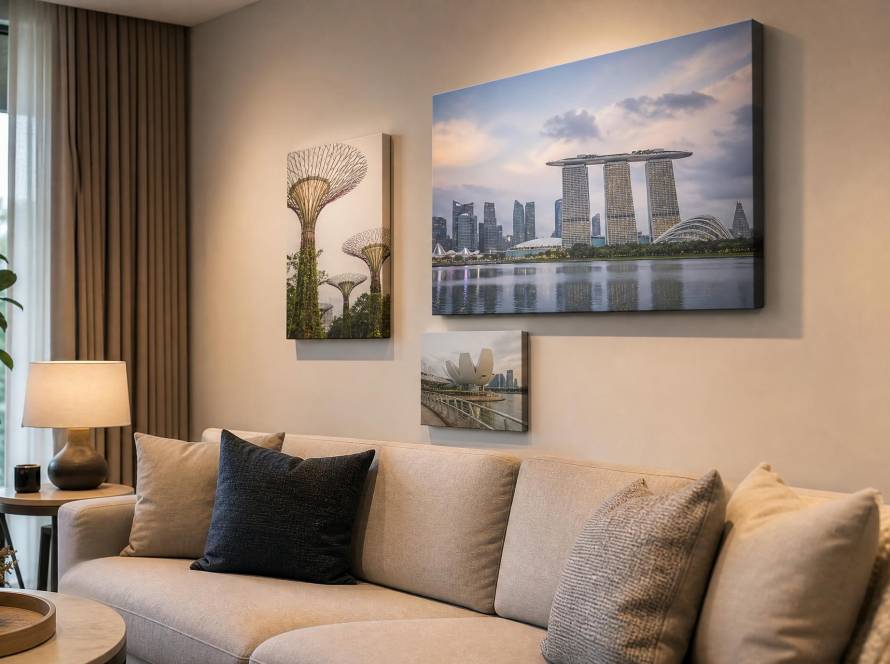
When your living space features tatami-style or low-profile flooring—a common choice in many Singapore HDB, BTO, and condo interiors—choosing the right canvas print size and placement becomes key to preserving a calm, uncluttered aesthetic. Unlike standard sofas and coffee tables, low-level seating changes sightlines and spatial rhythm, so your wall art needs to be proportioned accordingly. In this guide, we’ll walk through practical steps to size and hang canvas prints for tatami-inspired rooms, without resorting to guesswork.
Understanding tatami module measurements and room rhythm
Tatami mats typically measure around 0.9m by 1.8m in Singapore, though variations exist. The repeat of these modules creates a distinct horizontal rhythm across the room. To harmonise canvas prints with this layout, start by mapping out the tatami arrangement—whether it’s a single mat, a double mat, or a grid. The length of a single mat (1.8m) often becomes a natural reference for canvas width.
Imagine a common setup: a living room with two tatami mats placed side by side, forming a 1.8m x 1.8m seating area. The visual line from the floor to the eye level when sitting is about 1m to 1.1m. A canvas hung with its centre at that height will feel perfectly aligned with the traditional Japanese aesthetic. If you prefer a slightly higher placement, keep the bottom edge at least 30cm above floor level to avoid accidental bumps when people move around.
Low-hung canvas placement to complement floor seating
Unlike Western-style rooms where sofas dictate a 1.4m–1.6m centre height, tatami rooms call for a lower eye level. When sitting cross-legged on a floor cushion, your eyes are roughly 90–110cm from the floor. So the centre of your canvas should sit within that range. For example, a 60cm x 90cm canvas with its centre placed at 100cm from the floor will have its bottom edge at 55cm—comfortably above a seated person’s shoulders.
In Singapore homes, this is especially practical if you have toddlers who use the floor as a play area. Lower-hung art also draws attention down, making the room feel more grounded and intimate. Just be sure to use secure wall mounts, especially in humid conditions where adhesive hooks may fail. Always mount into wall studs or use suitable anchors for plaster or concrete walls.
Selecting canvas proportions for minimal, Zen-inspired layouts
Minimalist design favours clean lines. Canvas proportions that mirror the wide, low lines of tatami work best. A 2:3 landscape ratio (e.g., 60cm x 90cm) or a 4:5 ratio (e.g., 50cm x 62.5cm) tend to echo the horizontal emphasis of the mats. Square canvases (e.g., 60cm x 60cm) also work well if arranged symmetrically over a low bench or console table.
Avoid very tall portrait orientations, like 60cm x 150cm—they can visually compete with the low, restful feel of the floor. If you have a tall vertical wall, consider a series of small squares stacked in a grid rather than one tall rectangle. This maintains the modular rhythm. At Canvas Craft, we often recommend a single large canvas over multiple small ones for a truly Zen effect, as it reduces visual noise.
Colour and texture pairing with natural mat materials
Tatami matting typically comes in natural straw tones—warm beige, soft green, or earthy brown. Choose canvas prints that either complement or thoughtfully contrast these shades. Muted neutrals, soft greys, or subtle watercolour landscapes work well, as do prints with generous negative space. If your tatami has a stronger green tint, consider charcoal or indigo accents in the artwork to introduce a calm focal point.
Texture matters too. Canvas itself has a woven surface that pairs nicely with woven floor mats. At Canvas Craft, all our prints are finished with a satin coating that resists dust and light moisture—important given Singapore’s humidity. For extra protection, you might ask about a matte laminating layer, especially if the canvas is placed near a windowsill where condensation could occur. Remember to avoid hanging canvas in areas directly exposed to air-conditioning vents, as rapid temperature changes can cause warping.
Avoiding visual crowding: negative space strategies
In a tatami room, the floor itself is a major visual element. Overloading walls with many small frames creates clutter, which works against the calm spaciousness you’re aiming for. Instead, adopt a “less is more” approach. Keep at least 1.2m of clear wall space around your canvas—this gives the artwork room to breathe and allows the eye to rest.
If you must display multiple prints, space them generously. A triptych with gaps of 15–20cm between panels avoids a cramped look. Also, consider the relationship between the canvas and the tatami edges. Align the bottom edge of the canvas with the seam between two mats—this subtle alignment reinforces the modular pattern without being overly rigid.
Case study: 12m2 tatami corner layout with canvas sizing
Let’s apply these principles to a realistic Singapore interior. A 12m2 (3m x 4m) room might have a 2.4m x 2.4m area covered with six tatami mats (0.9m x 1.8m each) arranged in a 3 by 2 layout. Against one wall, you intend to hang a canvas above a low wooden bench. The bench is 35cm high, and seating height adds another 45cm, putting the eye at about 80cm when seated—slightly lower than average.
For this setting, a 60cm x 90cm landscape canvas works beautifully. Mount the centre at 95cm from the floor, leaving about 50cm between the bench top and the canvas bottom—a comfortable gap that avoids a closed-in feeling. The width of 90cm fits neatly within one and a half tatami widths (since each mat is 0.9m wide), creating a subtle visual tie. If you prefer a square, a 75cm x 75cm canvas centred at 100cm from the floor also works, but the landscape orientation better mirrors the horizontal lines of the mats.
To see real-world examples of such placements, browse our gallery where we showcase custom orders in similar settings. When you’re ready to order, our sizes and prices page lists standard dimensions, and we can also do bespoke sizes up to 120cm wide to match your tatami module exactly.
FAQ: Canvas Prints on Tatami Floors
1. Should I hang canvas prints lower than usual in a tatami room?
Yes. Because floor seating lowers your eye level, the canvas centre should be around 90–110cm from the floor, instead of 140–150cm used for sofa-back seating. Adjust based on actual seating position.
2. What canvas size is best for a small 3m x 3m tatami room?
Keep it modest—a 40cm x 60cm or 50cm x 75cm canvas is plenty. Oversizing a small room can feel overpowering. Use negative space to maintain a Zen vibe.
3. Can I use vertical portrait canvases above tatami?
It’s not ideal unless the wall is very tall and the canvas is narrow. A vertical rectangle may clash with the horizontal rhythm of the mats. If you love vertical art, choose a series of small squares stacked vertically.
4. How do I protect canvas prints from humidity in Singapore?
Canvas Craft prints are sealed with a satin coating that offers moderate moisture resistance. For added protection, ask about a matte laminate or avoid mounting in areas with direct AC airflow. Keep at least 2cm gap between the canvas and the wall for air circulation.
5. Can I match canvas width to a specific tatami mat width?
Yes, aligning the canvas width to a multiple of 0.9m (the width of a standard tatami) creates a strong architectural connection. A 90cm-wide canvas is a perfect match; a 60cm or 45cm can also work as fractions of that module.
For more inspiration and to explore ordering your custom canvas, visit our order page or check what other customers have created in our reviews section. At Canvas Craft, we’re happy to advise on sizing—just drop us a message with your room dimensions.