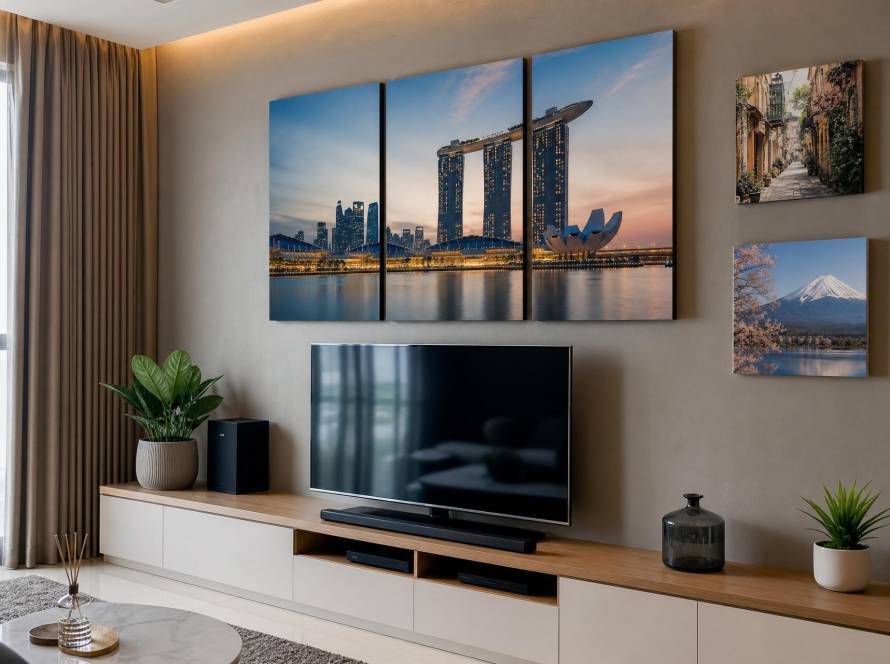
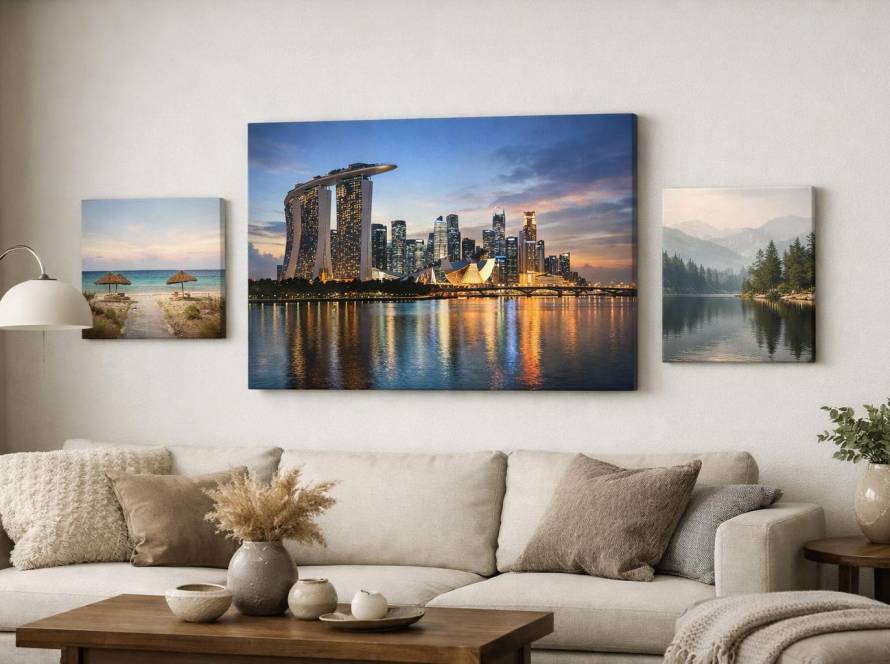
Choosing a canvas print size for an HDB living room is less about memorising a chart and more about matching a piece to the wall, the furniture and the way you actually use the room. This guide walks through the decisions that matter before you order, and it flags the points where you should verify details with the maker or a qualified professional rather than assume.
Start with the wall, not the artwork
Before browsing images, look at the wall you have in mind as a blank composition. Note its usable width and height, then subtract the space taken up by furniture, door swings, switches and anything that would crowd the edges. In many HDB living rooms the sofa wall is the natural focal point, but a narrower wall beside a dining area or along a walkway can also work well for a single statement piece.
Ask yourself a few planning questions:
- Which wall do people face when they sit down?
- Is the wall broken up by a doorway, window or built-in feature?
- How much clear wall remains once furniture is in place?
- Do you want the artwork to dominate the wall or sit comfortably within it?
These answers shape the size range you should be considering far more than any generic rule.
Viewing distance and visual scale
Scale is about relationship, not just numbers. A canvas that feels generous from across the room can feel overwhelming when you walk past it closely. Think about where people usually sit, stand or pause in the room, and how far those positions are from the wall.
A useful approach is to view the wall from your main seating position and imagine the artwork in place. If you can, mark the intended area with paper templates or removable tape to judge the proportions in real life. This is a visual check, not an installation method — for anything involving fixing the piece to the wall, follow the maker’s guidance or speak to a qualified professional.
As a general principle, larger walls and longer viewing distances tend to suit larger pieces, while tighter corners and closer viewing suit smaller ones. Treat this as a starting point for your own judgement rather than a fixed rule.
Single large piece vs gallery groupings
Both approaches can work well in compact homes, but they solve different problems.
A single large piece
- Creates one clear focal point
- Feels calm and uncluttered
- Works well on a wall with limited usable space
- Suits a strong, simple image
A gallery grouping
- Lets you tell a story across several images
- Can fill an awkward or irregular wall area
- Allows you to add or change pieces over time
- Needs more planning to feel balanced rather than busy
If you are unsure, start by deciding what you want the wall to do: anchor the room, or carry a collection of memories. That decision usually points you toward one option.
Orientation and aspect ratio
Orientation should follow the wall and the image, not the other way around.
- Landscape suits wide walls, above sofas and panoramic scenes.
- Portrait suits narrow wall sections, tall subjects and vertical spaces.
- Square feels balanced and works well in groupings or on walls that are roughly equal in width and height.
Also consider the aspect ratio of your photograph. Cropping a wide scene into a tall format, or the reverse, changes the composition. Decide what must stay in the frame before you settle on a shape.
Edge and depth considerations
The way a canvas is finished can affect how large it appears on the wall. A deeper edge can read as more substantial, while a slimmer profile can feel lighter. These are visual effects, not performance claims, and the right choice depends on the room and your taste.
Because finishes, materials and construction vary between makers, check the product documentation for what is actually offered. If a detail is not stated, ask before ordering rather than assuming.
Planning for common HDB living room layouts
Rather than prescribing exact dimensions, it helps to think in terms of relationships:
- Sofa wall: the artwork usually relates to the width of the sofa and the seating position opposite it.
- Feature wall: a single piece can carry the wall if the surrounding area is kept simple.
- Walkway or dining wall: smaller pieces or a tight grouping often suit narrower viewing distances.
- Open-plan area: consider how the piece reads from multiple angles and distances.
If you want to explore formats and options, you can browse the Canvas Craft gallery for visual reference. Canvas Craft is a Singapore canvas printing business, and customers can enter preferred dimensions on the Order page for a custom-size quotation.
A verification-first checklist before you order
Use this as a decision framework, and confirm anything uncertain with the maker or a qualified professional.
- Confirm the usable wall area after furniture and fixtures.
- Decide the main viewing position and how the piece will read from there.
- Choose single piece or grouping based on the wall’s role in the room.
- Match orientation and aspect ratio to both the wall and the image.
- Check the maker’s documentation for finishes, edges and construction details.
- Ask the maker directly about anything not clearly stated.
- Note the current condition of the wall and the space before making changes.
- For fixing or installation, follow the maker’s guidance or consult a qualified professional.
You can also review Canvas Craft’s FAQ for general ordering information, and see customer reviews for context on what others have chosen.
Frequently asked questions
How do I know if a canvas will be too big for my wall?
Judge it visually from your main seating position and, if possible, mark the intended area with paper templates. If it still feels uncertain, ask the maker for guidance based on your wall and viewing distance.
Should I choose one large canvas or several smaller ones?
It depends on whether you want a single focal point or a collection. A single piece suits a clear anchor wall; a grouping suits storytelling or an irregular space.
Can I order a custom size?
Canvas Craft offers custom canvas dimensions by quotation. You can enter your preferred dimensions on the Order page.
What should I check before ordering?
Confirm your usable wall area, viewing position, orientation and the maker’s documented finish options. Ask about anything that is not clearly stated.
Who should I ask about installation or wall fixing?
Follow the maker’s guidance or consult a qualified professional. This article focuses on visual planning, not installation methods.