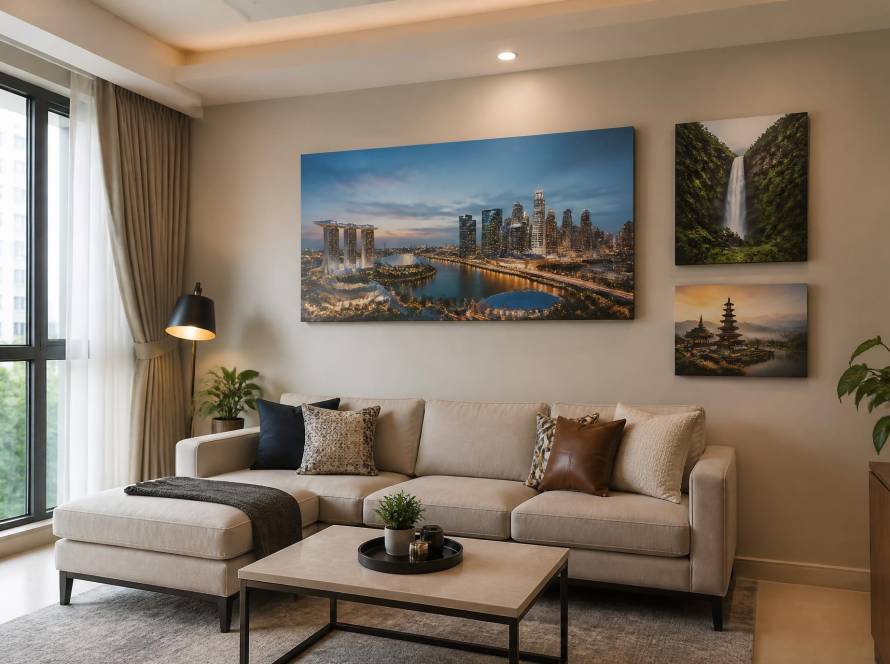
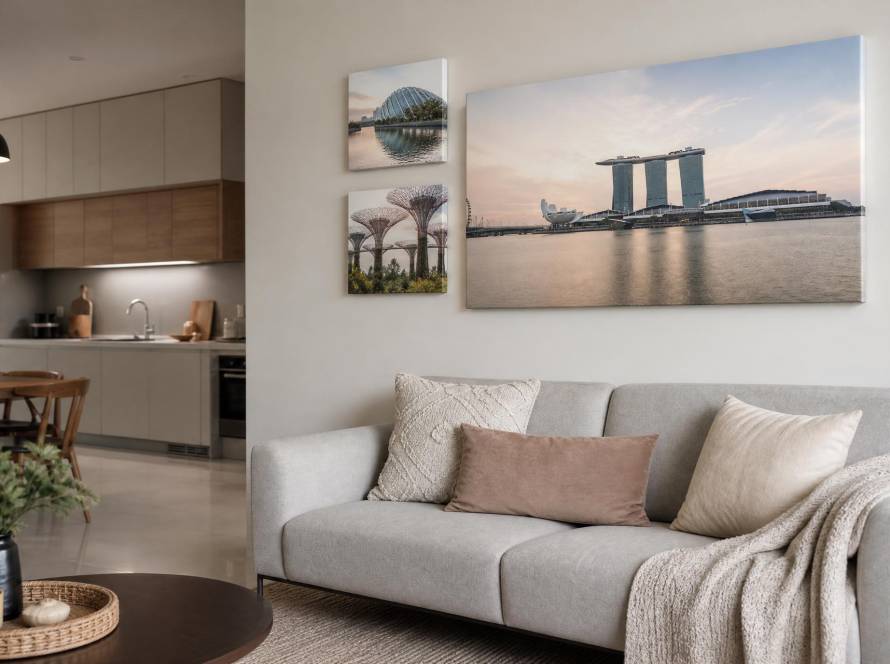
Choosing a canvas size is less about finding one “correct” number and more about matching the artwork to the wall, the furniture and the way you actually use the room. In an HDB living room, where the sofa wall often doubles as the TV wall and the walkway, that balance matters. This guide walks through the decisions in a practical order: assess the wall, think about viewing distance, choose a layout, match the photo’s shape, then test it before you commit.
Start with the wall, not the artwork
Before browsing sizes, look at the wall you have in mind and note what shares it. In many HDB living rooms the main candidates are the wall behind the sofa, the wall beside or behind the TV, and a narrower stretch near the dining area or entryway. Each has different constraints.
Furniture relationships
A canvas usually reads best when it feels connected to a piece of furniture rather than floating alone. Above a sofa, the artwork should feel visually tied to the sofa’s width — not so small that it looks lost, and not so wide that it spills past the sofa’s edges and competes with neighbouring walls or doorways. The same logic applies above a console, a sideboard or a bedhead.
Wall widths and interruptions
HDB living room walls are often interrupted by doorways, windows, air-conditioning units, switches or trunking. Treat the clear, uninterrupted stretch as your real canvas area. A wall that looks generous at a glance can shrink once you subtract these elements. Note where the clear space begins and ends, and whether the artwork would sit centred on the wall or centred on the furniture below it — these are often different, and the furniture usually wins.
How viewing distance shapes your choice
Viewing distance is the single most useful idea in size selection. A canvas seen from across the room can carry more detail and a larger format than one you pass at close range in a narrow corridor.
In a typical living room, the main viewing position is the sofa. Ask yourself how far the sofa sits from the wall in question, and whether people mostly look at the artwork while seated, while walking past, or both. A large canvas on the sofa wall is usually viewed from a comfortable distance, which gives it room to be bold. A canvas in a walkway or beside a doorway is seen up close and in passing, so a calmer, simpler image often works better there.
This is also why the same photo can feel right at one size in one room and wrong at the same size in another. The image has not changed; the viewing distance has.
Single large canvas versus multiple panels
Both approaches can work well in an HDB living room, but they solve different problems.
A single large canvas
- Strengths: Gives one image full presence, keeps the wall calm, and suits a strong photograph with a clear subject. It is often the simpler choice for a first canvas purchase.
- Watch-outs: A single canvas can look undersized on a wide wall if it is chosen without checking the furniture relationship. It also puts all the visual weight in one place, so the image needs to hold attention on its own.
Multiple panels
- Strengths: Lets you spread visual weight across a wider wall, works well above long sofas, and can make a panoramic photo feel more deliberate. Panels can also let you group related images — for example, a set of family moments or travel scenes.
- Watch-outs: Gaps between panels become part of the composition, so alignment and spacing need planning. A multi-panel set also asks more of the viewer: the eye moves between panels, which can feel busy in a small or cluttered room.
A useful rule of thumb is to choose the layout that matches the wall’s proportions. A long, low wall above a sofa often suits a wide single canvas or a horizontal panel set. A taller, narrower wall may suit a portrait canvas or a vertical stack.
Aspect ratio and cropping: fitting the photo to the format
Canvas sizes come in different proportions, and your photo has its own. The gap between the two is where cropping decisions happen.
- Landscape photos suit wide formats and are the natural fit for most sofa walls. Check that the crop does not cut off key subjects at the edges.
- Portrait photos suit taller formats and work well on narrower walls or beside furniture. Be careful with group shots, where a tall crop can squeeze people together.
- Panoramic photos suit very wide formats or multi-panel sets. Panoramics often lose impact if forced into a standard rectangle, so consider whether the scene reads better as a strip or across panels.
Before ordering, look at your photo at the intended proportions and decide what can be trimmed. Faces, hands and distinctive landmarks are usually the parts you want to protect. If a crop would remove something important, a different format may be the better answer than a different size.
Measure and mock up before you commit
Paper templates are a simple, low-cost way to test scale. Cut paper or card to the intended canvas proportions and fix it temporarily to the wall with removable tape — no drilling or permanent fixing needed. Step back to your usual viewing position and look at it over a day or two. Templates quickly reveal whether a size feels too timid, too dominant, or just right.
Smartphone apps and simple photo mock-up tools can also help. A photo of your wall, with a canvas shape overlaid, gives a rough sense of proportion and colour balance. Treat these mock-ups as a guide rather than a guarantee: screen colours and room lighting differ, and a mock-up cannot fully show how a canvas will sit against your actual wall finish.
If you are ordering a custom size, Canvas Craft allows customers to enter preferred dimensions on the Order page, which makes it easier to match a template you have already tested. You can also browse the gallery for a sense of how different formats look in practice.
Visual balance with furniture and TV screens
In many HDB living rooms, the TV is the loudest object on the wall. A canvas placed near it should either hold its own or clearly play a supporting role — trying to do both usually looks unsettled.
If the canvas shares a wall with the TV, consider whether it sits at the same visual level or deliberately offset. Aligning the canvas with the TV’s centre line can look orderly; offsetting it can create a more relaxed arrangement. Either way, leave visual breathing room so the two do not crowd each other.
Above a sofa, the canvas usually works best when its width relates to the sofa rather than to the wall as a whole. A canvas that is noticeably narrower than the sofa can look like a stamp; one that runs past the sofa’s edges can make the seating feel off-centre. The goal is a relationship that looks intentional from the main viewing position.
Size thinking by room and wall type
Rather than fixed numbers, think in terms of scale relative to the wall and furniture.
Main sofa wall
This is usually the largest clear wall and the one seen from the furthest viewing distance. It can carry a bolder single canvas or a wider multi-panel set. Prioritise the sofa relationship and check that the canvas does not crowd doorways or walkways.
TV wall
Often busier, with the screen, media console and cables. A smaller or more restrained canvas may work better here, or a canvas placed to one side rather than directly above the TV.
Dining or entryway wall
Usually narrower and viewed closer. A portrait canvas, a small landscape, or a tight group of smaller pieces often suits these spaces better than one large statement piece.
Bedroom walls
Viewed from close range and in calmer moments. Quieter images and moderate sizes tend to feel more restful than very large, high-contrast pieces.
Frequently asked questions
How do I know if a canvas is too small for my wall?
If the canvas looks disconnected from the furniture below it, or leaves large empty stretches on both sides, it is probably undersized for that wall. A paper template at the intended proportions will show this quickly.
Should I choose one large canvas or several panels?
Choose a single canvas when you want one image to carry the wall and keep things calm. Choose panels when the wall is wide, the photo is panoramic, or you want to spread visual weight across the space.
Can I use a portrait photo on a wide wall?
Yes, but consider the balance. A single portrait canvas on a very wide wall can look isolated; a group of portrait canvases, or a portrait canvas paired with other elements, often works better.
What if my photo does not fit the canvas proportions?
You will need to crop or choose a different format. Decide which parts of the image must stay — faces, key landmarks — and check the crop at the intended proportions before ordering.
Can I order a custom canvas size?
Canvas Craft offers custom canvas dimensions by quotation; you can enter your preferred dimensions on the Order page. For general questions, the FAQ page is a good starting point.
Bringing it together
Good canvas sizing is a sequence of small, practical decisions: measure the clear wall, note the furniture relationship, think about viewing distance, choose a layout that suits the photo’s shape, and test the scale with a template before ordering. None of these steps requires precise formulas — just careful looking. Done in that order, the size decision usually becomes obvious well before you reach the checkout.