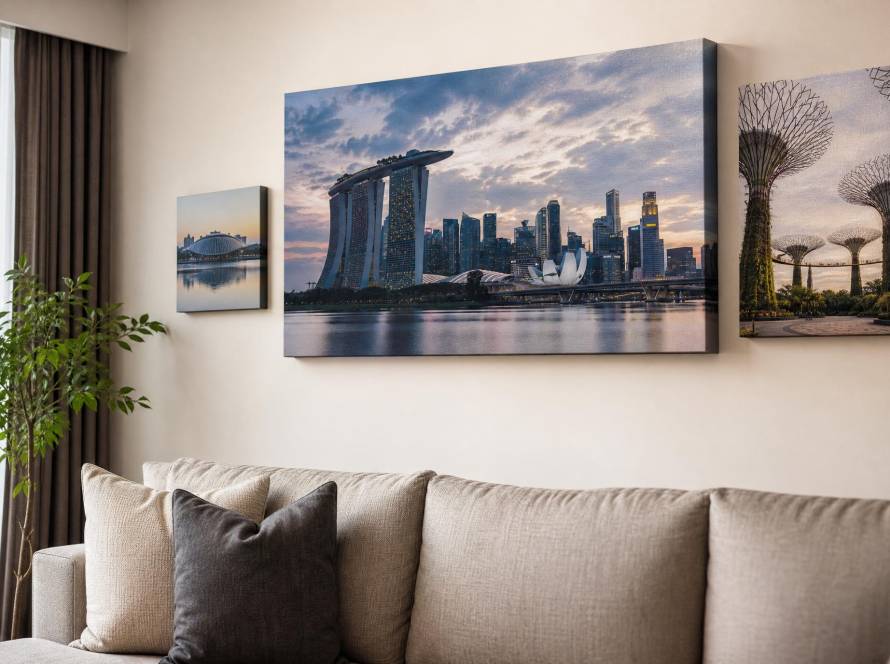
If you design interiors for homes or offices, canvas prints are an easy way to finish a space without heavy frames. The details of the canvas build, especially the wrap and depth, will affect how your project photographs and how it feels in real life.
Here is a quick, practical guide written from the point of view of a print maker who also shoots professionally.
1. Match wrap style to design language
For a clean, contemporary project:
-
Favour mirror or solid colour wrap
-
Avoid busy gallery wraps where faces or furniture details spill over the edges
For eclectic or bohemian spaces:
-
Gallery wrap can add a relaxed, casual feel, especially for travel imagery and textures
For corporate or hospitality work:
-
Solid colour wrap on a slightly deeper frame reads more like a framed piece without the reflective glass
2. Consider how it will photograph
Your project will likely be photographed from multiple angles.
-
Gallery wrap: side angles show a continuation of the image. Good for abstract or texture-heavy art.
-
Mirror wrap: side angles show soft, blurred repetitions, which is usually safe.
-
Solid colour wrap: side angles show a clean block of colour that can echo cabinetry or wall paint.
If you know the primary camera angle, tell your printer. We can ensure no key content disappears around the edges in that viewpoint.
3. Canvas depth and shadow line
Standard stretched canvases sit about 3.5 to 4 cm off the wall. For most HDB and condo projects this is enough.
In larger landed homes or offices, a slightly deeper frame can:
-
Cast a more pronounced shadow that reads well in photographs
-
Make the art feel more substantial next to millwork and built-ins
If you are working on a project where depth matters, specify it in your mood board so prints, carpentry and lighting all play nicely together.
4. Groupings that suit professional spaces
Some layouts that work well for designers and architects:
-
Reception counter: three 60 × 40 cm canvases in a row, aligned to the counter length
-
Meeting room: one 105 × 70 cm canvas centred on the main wall
-
Corridor: a rhythm of 45 × 30 cm canvases at regular intervals
Keep the gap between canvases consistent across the whole project. That visual rhythm is what makes the installation feel intentional.
5. Practical notes for handover and maintenance
-
Surface: Our museum-grade canvas has a soft satin finish that avoids glare from downlights.
-
Cleaning: A light feather duster is usually enough. For fingerprints on the wrap, a slightly damp microfibre cloth works.
-
Future changes: Because canvases are relatively light, they can often re-use existing wall plugs when you refresh images in a few years.
If you specify mirror or solid colour wrap, replacing a single piece in a series later is easier. You do not risk unpredictable cropping at the edges.
6. Discuss wrap and sizing early
Wrap style is easiest to decide when you are still in the planning and sourcing phase.
If you share your 3D visuals or sketches with us:
-
We can recommend wrap styles and depths that support your concept
-
We can flag any images that need extra bleed or retouching to work as gallery wraps
-
You get prints that drop into the space without surprises at site
For clients, these are small details. For you as the designer, they are part of what makes the finished project feel tight and professional.