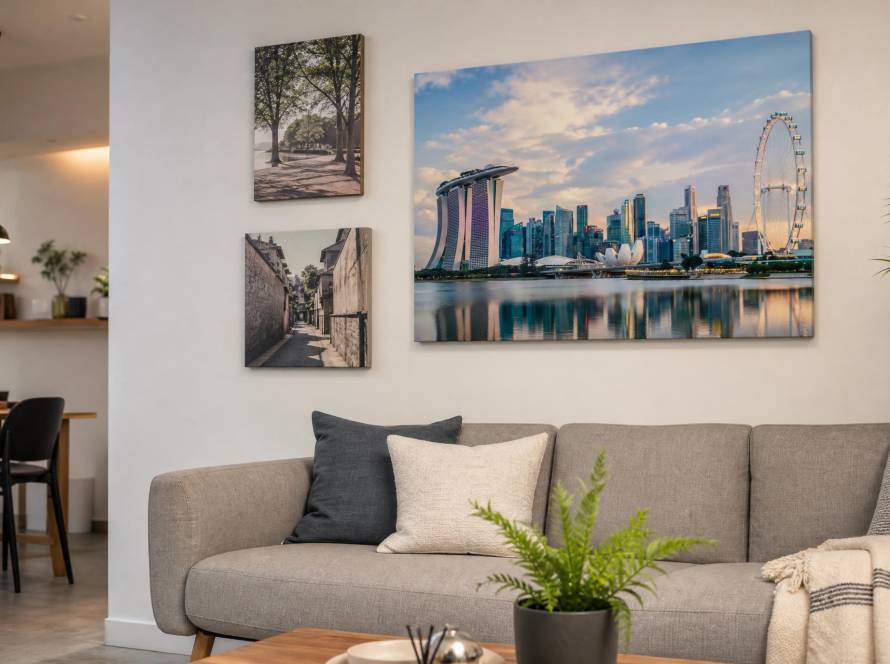
A gallery wall can make a compact Singapore apartment feel personal and considered, but it is easy to end up with a cluster of frames that looks busy rather than cohesive. The good news is that a strong canvas wall art layout is mostly about planning: choosing a theme, balancing sizes and colours, and testing the arrangement before anything goes on the wall. This guide walks through a practical planning process you can adapt to your own space, whether you are displaying family photos, travel memories or a mix of canvas and framed prints.
Start with a theme and colour palette
Cohesion begins before you choose a single frame. A gallery wall feels intentional when the pieces share something, whether that is subject matter, mood or colour. Ask yourself what the wall is for. Is it a family memory wall in the living room, a calm focal point in the bedroom, or a gift display for a new home? The answer will guide your choices.
Choose a unifying idea
Common themes include family and milestones, travel and places, nature and botanicals, or abstract shapes and textures. You do not need every piece to match exactly. A shared theme gives the eye something to follow, even when the images themselves are different.
Build a simple palette
Pick two or three dominant colours and repeat them across the arrangement. If your sofa or rug has a warm neutral tone, for example, you might lean toward canvases with similar warm tones and one accent colour. Repeating a colour in different pieces ties the wall together without making it look uniform. For inspiration on how printed canvases can look in a room, you can browse the Canvas Craft gallery.
Mix canvas sizes and shapes for visual interest
A gallery wall does not need to be a grid of identical frames. Mixing sizes and shapes can make the arrangement feel more dynamic, but it needs a structure. A common approach is to choose one larger anchor piece and surround it with smaller pieces. The anchor gives the eye a starting point, while the smaller pieces add detail.
Balance rather than match
Think about visual weight. A large, dark canvas will feel heavier than a small, light one. Try to distribute heavier pieces across the wall rather than clustering them on one side. If you are using a mix of portrait and landscape orientations, alternate them so the arrangement feels balanced rather than lopsided.
Keep the gaps consistent
Consistent spacing between pieces is one of the simplest ways to make a mixed arrangement look cohesive. Rather than measuring exact gaps, aim for a rhythm that feels even to the eye. You can use paper templates to check this before committing. If you are planning a custom canvas size, Canvas Craft allows customers to enter preferred dimensions on the Order page for a quotation.
Plan for small walls and compact rooms
In a compact apartment, a gallery wall can easily overwhelm a room if it is too dense or too large for the available wall space. Before you plan the layout, step back and look at the wall from the main viewing position. Consider how much breathing room the arrangement needs around it, and whether the wall is a focal point or a background.
Work with the wall you have
Narrow walls often suit a vertical column or a tight cluster of smaller pieces, while wider walls can take a more spread-out arrangement. If the wall is shared with furniture, such as a sofa or console, the gallery should relate to the furniture rather than float independently. A useful rule of thumb is to keep the arrangement visually connected to the furniture below it, so the wall and the room feel like one composition.
Consider sightlines
Think about where people will stand or sit when they look at the wall. A gallery that is planned for a standing viewer may feel too high when seen from a sofa. Paper templates taped to the wall can help you check the arrangement from different angles before you commit.
Test layouts with templates and mock-ups
One of the most practical steps in planning a gallery wall is to test the layout before anything is fixed to the wall. Cut paper or card to the same size as each canvas or frame, then arrange the pieces on the floor or tape them to the wall. This low-cost mock-up lets you see how the sizes and shapes work together and adjust the arrangement without making unnecessary holes.
Photograph your mock-up
Take a photo of your paper layout from the main viewing position. Looking at a photo can reveal imbalances that are harder to spot in person, such as a cluster that feels too heavy on one side or a gap that looks awkward. You can also use the photo to compare different arrangements side by side.
Check the relationship with furniture
As you test the layout, pay attention to how the gallery relates to nearby furniture, such as a sofa, sideboard or bed. The arrangement should feel anchored rather than disconnected. If you are unsure, try shifting the whole layout up or down slightly and see which position feels more comfortable.
Combine canvas with framed prints and other decor
Mixing canvas prints with framed artwork, mirrors or small wall objects can add texture and personality to a gallery wall. The key is to keep the mix intentional. A shared colour palette or theme will help different materials feel like they belong together.
Create rhythm with materials
Alternate canvas and framed pieces so that one material does not dominate. If you include a mirror or a sculptural object, treat it as part of the composition rather than an afterthought. The goal is a wall that feels layered but not cluttered.
Keep the frame styles simple
If you are using framed prints alongside canvas, consider keeping frame styles relatively simple so the images remain the focus. A consistent frame colour or finish can help unify pieces that are otherwise quite different.
Anchor the gallery to furniture and architectural features
A gallery wall feels more grounded when it relates to something else in the room. Common anchors include a sofa, a console table, a bed or a prominent architectural feature such as a window or a recessed wall. Aligning the gallery with the furniture below it helps the arrangement feel deliberate.
Use vertical and horizontal lines
Look for lines in the room that you can echo in your layout. The top of a sofa, the edge of a console or the line of a window can suggest where the gallery should sit. Aligning the bottom or top edge of the arrangement with one of these lines can create a sense of order.
Leave breathing room
Resist the urge to fill every inch of wall space. Leaving some empty wall around the gallery helps the arrangement stand out and prevents the room from feeling crowded. In a compact apartment, this breathing room is especially important.
Lighting and placement for impact
Lighting can change how a gallery wall looks throughout the day. Consider how natural light falls on the wall and whether the colours in your canvases will read clearly in different conditions. If the wall is in a dark corner, you may want to choose lighter or brighter images to keep the arrangement from feeling heavy.
Think about glare and shadows
If the wall faces a window, check whether glare or shadows affect the viewing experience. You may need to adjust the placement or choose images that work well in the available light. For rooms used mostly in the evening, warmer lighting can make the gallery feel cosy.
Keep the focal point clear
In a small room, a gallery wall can become the focal point. Make sure the arrangement does not compete with other strong features, such as a television or a large piece of furniture. If the wall is already busy, a simpler layout may work better.
Plan before you install
Before you move from planning to installation, review your layout one more time. Check that the arrangement feels balanced from the main viewing position, that the spacing is consistent, and that the gallery relates well to the furniture and architecture around it. If you are unsure about any part of the installation, consult the manufacturer’s guidance or a professional. For general questions about canvas prints, you can refer to the Canvas Craft FAQ.
A cohesive gallery wall is less about following strict rules and more about making deliberate choices. By planning your theme, palette, sizes and placement, you can create a wall that feels personal and put-together, even in a compact Singapore apartment.
Frequently asked questions
How do I choose a theme for a gallery wall?
Start with the purpose of the wall and the mood you want to create. A shared subject, colour palette or style can unify different pieces without making them look identical.
Can I mix canvas prints with framed artwork?
Yes. Mixing materials can add texture and interest. Keep the arrangement cohesive by repeating colours or themes and by balancing the visual weight of different pieces.
How do I test a gallery wall layout without making holes?
Cut paper templates to the size of each piece and tape them to the wall. This lets you adjust the arrangement before installing anything. Taking a photo of the mock-up can also help you spot imbalances.
Where should a gallery wall be placed in a small apartment?
Choose a wall that relates to your furniture and daily sightlines, such as above a sofa or console. Avoid overcrowding the wall and leave some breathing room around the arrangement.
Can I order custom canvas sizes for a gallery wall?
Canvas Craft offers custom canvas dimensions by quotation. You can enter your preferred dimensions on the Order page to request a quote.