

Practical guidance to pick canvas dimensions that suit HDB living rooms
Choosing the right canvas size for an HDB living room is mostly about proportion and placement. This guide gives clear, localised advice for common HDB furniture layouts and wall proportions, whether you’re decorating your BTO, upgrading a resale flat, or buying a gift for a friend in Singapore.
Typical HDB living room proportions and sightlines
HDB living rooms tend to be more compact than many landed or condominium layouts. Ceiling heights in many HDB flats are around 2.5–2.7 metres and walls are often used for both circulation and display. Because sightlines are usually close — you view artwork from sofas, dining chairs or standing at the entrance — scale and distance matter more than in larger homes.
Before selecting a canvas, measure the wall area you intend to use, the width of nearby furniture (especially sofas), and the distance between sofa and wall. These simple measurements guide whether you choose a single large canvas, a vertical piece, or a multi-panel configuration.
How furniture placement affects canvas width and height
Furniture acts as the visual anchor in a living room. The general rule is that artwork above or behind furniture should feel visually connected to it — neither dwarfed by the furniture nor overwhelming the space.
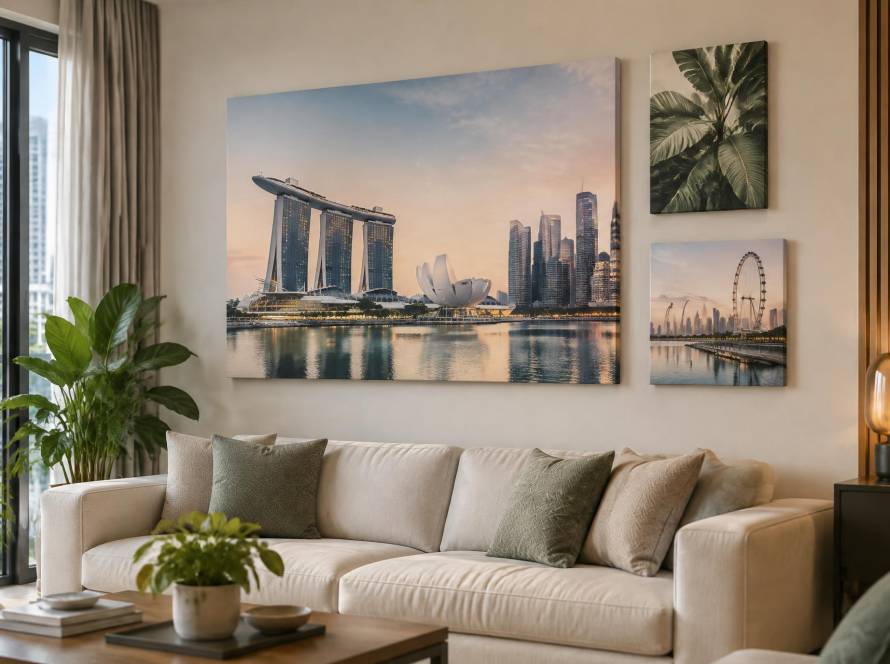
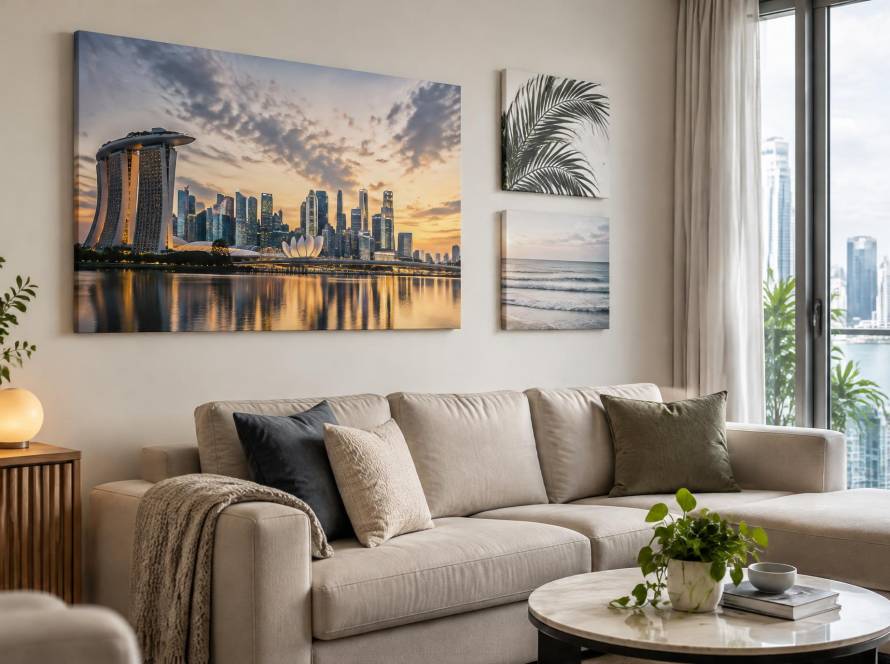
A commonly-used proportion for art above a sofa is: artwork width should be roughly 60–75% of the sofa width. This keeps the piece balanced and avoids a cramped or floating look.
Recommended canvas widths for 3-seater and 2-seater sofa setups
- 3-seater sofa (approx. 180–220 cm): choose a canvas width of about 110–165 cm. Typical sizes: 120 x 80 cm, 140 x 90 cm, or 150 x 100 cm.
- 2-seater / small sofa (approx. 120–150 cm): choose a canvas width of about 70–110 cm. Typical sizes: 80 x 60 cm, 90 x 60 cm, or 100 x 70 cm.
Height depends on wall height and how much space you want between the sofa and the bottom of the canvas. For lower walls, lean toward shallower canvases (e.g. 60–90 cm tall). For taller feature walls, taller canvases (100–120 cm) can work if the room can accommodate viewing distance.
Vertical vs horizontal canvases in narrow living rooms
In narrow HDB living rooms, horizontal canvases can help widen the perceived space when placed above the sofa or TV console. Vertical canvases, on the other hand, draw the eye up and can make a low ceiling feel taller — useful for a short entry wall or a narrow corridor-like living area.
When to choose vertical:
- When you have a narrow wall segment between windows or doors.
- To create a visual lift on lower ceilings (but be careful not to use an overly tall piece that can feel crowded in close quarters).
When to choose horizontal:
- Above sofas and TV consoles — supports the horizontal sweep of furniture.
- When you want to visually expand the room’s width.
Using multi-panel canvases (diptychs and triptychs) for HDB walls
Multi-panel canvases are popular in HDB homes because they allow flexible sizing and add rhythm to a wall without relying on one very large frame. A diptych (2 panels) or triptych (3 panels) can be scaled to match a sofa or long console.
- Decide the total width you want first (for example, 140 cm). Split it into panels — a triptych might be three 45 x 60 cm panels with 2–4 cm spacing between panels.
- Keep panel spacing consistent. In tight living rooms, 2–3 cm between panels is usually enough to read them as a single composition without crowding the wall.
- Use panels to break a large image into digestible parts; visually it can feel lighter than one massive canvas, which suits HDB living rooms well.
Spacing and eye-level guidelines for family-sized living rooms
For family living rooms where people of different heights use the space, aim for a practical compromise on eye level and spacing:
- Eye level: the centre of the artwork should be about 145–155 cm from the floor for most adult viewers. If you often have children or elderly family members, consider lowering the centre to around 135–145 cm.
- Distance from furniture: leave about 10–20 cm between the top of a sofa or console and the bottom edge of the canvas to avoid a cramped look. If there’s a shelf or a high-back sofa, increase that gap slightly.
- Group spacing: when placing multiple canvases together, keep 8–20 cm between separate artworks. Use the smaller end for tight walls and the larger end for more open arrangements.
Also consider humidity and sunlight: Singapore’s climate can affect canvas materials over time. Avoid direct sun on prints and keep them away from frequent splash zones (e.g. right next to the kitchen). If you expect higher humidity near balconies or service yards, choose a sealed or varnished finish; at Canvas Craft we recommend a protective finish for homes that experience higher moisture or direct sunlight.
Case study: 5 layout examples with suggested canvas sizes
Below are common HDB living room scenarios and practical canvas size suggestions. All measurements are examples — measure your own walls before ordering.
1) Compact living room with a 3-seater sofa (200 cm)
Scenario: Sofa sits against a single short wall in a BTO flat. Viewing distance is about 2–3 metres.
Recommended: single horizontal canvas 140 x 90 cm (or 150 x 100 cm if you want a stronger focal point). Leave 10–15 cm gap above sofa.
2) Narrow lounge with a 2-seater sofa (140 cm)
Scenario: Wall between two windows or beside an entrance hallway.
Recommended: vertical canvas 60 x 90 cm to lift the ceiling visually, or a horizontal 90 x 60 cm if placed above a small console.
3) Long wall behind a TV console
Scenario: Low console with TV; wall area is wide but low in height.
Recommended: triptych with total width 160–180 cm, for example three panels 50 x 70 cm with 2–3 cm gaps — this keeps the canvas proportionate to a long console without interfering with the TV.
4) Feature wall beside balcony or sliding doors
Scenario: Tall narrow feature wall where a vertical focal point is needed.
Recommended: two-panel diptych stacked vertically or a single tall canvas 80 x 120 cm. Ensure curtains or sliding doors do not block the artwork.
5) Open-plan living and dining area
Scenario: One continuous wall shared between living and dining zones.
Recommended: larger horizontal canvas 180 x 100 cm above the sofa zone, or split into a diptych totaling a similar width. Maintain separate anchors for the dining table (e.g. a smaller 60 x 90 cm piece) so the artwork reads by zone.
Quick checklist before you order a canvas for an HDB living room
- Measure the wall width and the furniture width you want the canvas to coordinate with.
- Decide single-piece or multi-panel; mock up the dimensions with paper cut-outs if you’re unsure.
- Check viewing distance — if you sit close, prefer smaller or shallower canvases; if you have more space, larger canvases work.
- Consider placement height: aim for centre at 145–155 cm unless you need a family-adjusted height.
- Account for humidity and sunlight — choose a protective finish for exposed areas. Canvas Craft offers material options suited to Singapore conditions.
- Measure door swings, curtains and nearby fixtures so the canvas won’t be partially hidden after installation.
FAQ
Q: How do I know whether to pick a single large canvas or a triptych?
A: Use the wall’s width and the furniture anchor to decide. If you want a single bold focal point and have enough wall space, choose a single large canvas. Use a triptych when you want flexibility, lighter visual weight, or to fill a wide span without one heavy frame.
Q: What size looks best above a 3-seater sofa?
A: Aim for artwork width that’s about 60–75% of the sofa width. For a 180–200 cm sofa, that usually means canvases in the 110–150 cm width range.
Q: Are there finishes that are better for Singapore’s humidity?
A: Yes. A sealed or varnished finish and well-stretched canvas reduces moisture ingress. Avoid placing canvases in direct sunlight or in areas that get splashed or steamed regularly, such as close to an open kitchen.
Q: Can I customise panel spacing on multi-panel canvases?
A: Yes. For HDB homes, 2–4 cm between panels is a practical range. Smaller gaps feel cohesive on compact walls; larger gaps work where you want more separation.
If you’d like a quick floor-plan check or examples of sizes, our gallery has local instal examples and the Sizes & Prices page lists available dimensions. When you’re ready, the Order page makes custom sizing straightforward. Canvas Craft is experienced with Singapore homes and can help you pick proportions that suit your HDB living room.


3 Comments
Esperanza2137
Get paid for every referral—sign up for our affiliate program now!
Hendrix2080
Promote, refer, earn—join our affiliate program now!
Oliver4077
Share your link and rake in rewards—join our affiliate team!