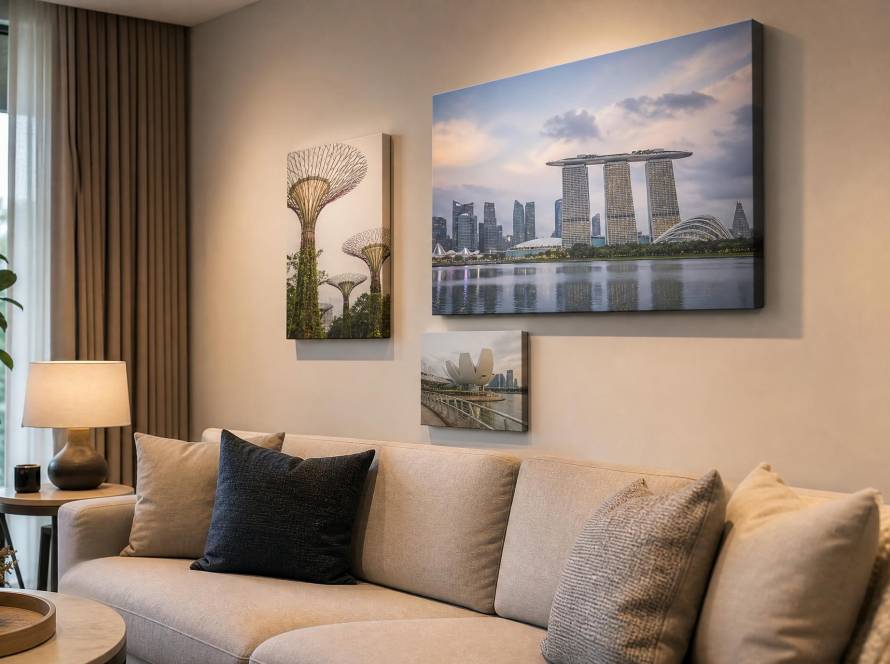
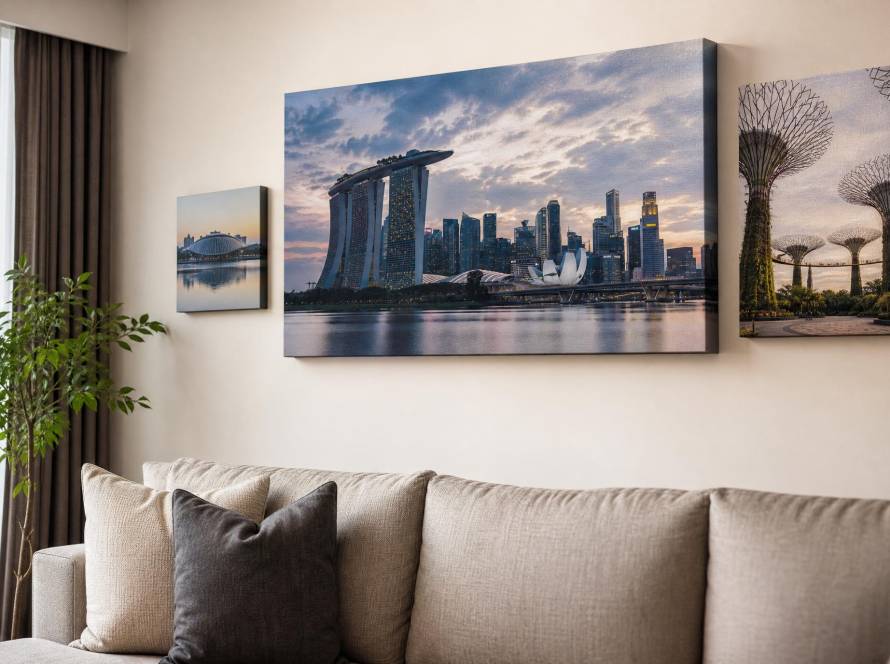
Hanging canvas wall art well is less about following one universal number and more about matching the artwork to the room, the furniture and the way people actually use the space. In Singapore homes, where living rooms often double as dining areas and walls may be shared with windows, air-conditioning units or built-in carpentry, a little planning goes a long way. This guide walks through the main placement decisions so you can choose a height that feels balanced rather than arbitrary.
Why Eye Level Is Only a Starting Point
The familiar advice is to hang art so its centre sits around eye level. The logic is simple: when most people stand or sit in a room, their natural gaze falls somewhere near that band, so the artwork meets the eye without effort. It is a useful default when there is no furniture to anchor the piece.
But eye level is not a fixed measurement. It changes with the height of the people in the household, whether they are usually standing or seated, and what the artwork is meant to do. A piece above a sofa is viewed from a seated position, so the visual centre often needs to sit lower than a piece in a hallway viewed while walking. A canvas in a child’s room is viewed from a lower height again.
Treat eye level as a reference band, not a rule. The real question is: from where will this canvas usually be seen, and does the composition sit comfortably in that line of sight?
Above the Sofa: Anchor to the Furniture, Not the Wall
The sofa is the most common anchor for canvas wall art in Singapore living rooms, and it is also where height mistakes are most visible. A canvas that floats too high leaves a gap that makes the sofa and the art feel disconnected. A canvas that sits too low can feel crowded, especially if people lean back or the sofa has a high back.
A practical approach is to think in terms of relationship rather than exact numbers. The bottom edge of the canvas should feel visually connected to the top of the sofa, close enough that the two read as one arrangement. The centre of the artwork should then fall roughly in the seated viewer’s line of sight.
If the sofa is against a wall with a console table, lamp or side unit nearby, use those elements as additional reference points. The canvas should feel like it belongs to the same visual group. When in doubt, paper templates taped to the wall can help you judge the relationship before anything is fixed in place.
Above the Bed: Wider Pieces, Lower Centres
Bedroom canvases are usually viewed from a seated or lying position, which changes the ideal height. A piece above the bed often works best when it is wide enough to relate to the width of the bedhead, and when its centre sits lower than a standing eye-level placement would suggest.
In Singapore bedrooms, where space can be tight and wardrobes may run close to the bed, it also helps to consider how the canvas relates to surrounding built-ins. A canvas that is too tall or too high can make a compact room feel top-heavy. A wider, calmer composition often sits more comfortably.
If the bed has a tall headboard, the canvas should relate to the headboard rather than to the ceiling line. If the headboard is low or the bed is against a large blank wall, the canvas may need to sit slightly lower to avoid a floating feeling.
Dining Areas and Kitchens: Consider the Seated View
Dining areas are usually viewed from a seated position, often across a table. This means the canvas should generally sit lower than a hallway piece, with its centre aligned to the seated diner’s gaze. A canvas placed too high above a dining table can feel disconnected from the table and the people around it.
Kitchens present a different challenge. Walls may be interrupted by cabinets, backsplashes, windows or appliances, so a canvas may need to fit within a defined band rather than follow a standard height. In these cases, the artwork’s relationship to the cabinetry and the worktop matters more than any general rule.
If the canvas is meant to be seen mainly from a nearby living area, treat it as part of that wider view. If it is meant to be seen while cooking or washing up, consider the standing sightline instead.
Staircases and Hallways: Adjust for Movement
Staircases and hallways are transitional spaces. People are usually moving, and the viewing angle changes as they walk. This makes a single perfect height less important than a consistent visual rhythm.
On a staircase, a canvas is often seen from below, from the side, or while ascending. A piece that sits too high may only be visible from the top steps, while one that sits too low may be missed entirely. In many homes, a series of smaller canvases following the line of the stairs feels more natural than one large piece.
In hallways, the canvas is usually viewed while walking towards or past it. A slightly higher placement can work here because the viewer is standing and moving, but the piece should still feel connected to the wall rather than floating near the ceiling. If the hallway is narrow, a canvas that is too large or too high can feel overwhelming.
Children’s Rooms: Bring Art Into Their World
In children’s rooms, the viewer is shorter, and the room is often used in different ways: playing on the floor, sitting on the bed, reading in a corner. A canvas placed at adult eye level may sit far above a child’s natural line of sight.
A lower placement, related to the bed, a low shelf or a play area, often works better. This does not mean the canvas should be within reach if that is a concern, but it should feel like part of the child’s space rather than an adult decoration imposed from above.
Consider what the child will see from their bed or from the floor. A canvas that is visible from those positions is more likely to be enjoyed day to day.
Grouping Multiple Canvases: Alignment and Baseline Options
When hanging more than one canvas, height decisions multiply. The goal is usually to create a sense of order without making the group feel rigid.
There are two common approaches. The first is to align the centres of the canvases, which creates a strong horizontal line through the middle of the group. The second is to align the bottom edges, which creates a shared baseline and often feels more grounded, especially above furniture.
A third option is to align the top edges, which can work well when the canvases are different heights but share a common top line. This is often used in hallways or above a long piece of furniture.
Whichever approach you choose, keep the gaps between canvases consistent. Uneven spacing draws the eye to the gaps rather than the artwork. Paper templates can help you test the arrangement before committing.
If you are planning a group, it also helps to think about the overall shape the group makes. A rectangular block feels formal; a more organic arrangement feels relaxed. Neither is wrong, but the choice should suit the room.
Practical Planning Questions Before You Hang
Before deciding on a height, ask a few simple questions:
- Where will people usually be when they look at this canvas: standing, seated, lying down or moving past?
- What furniture or architectural feature should the canvas relate to?
- Is the canvas part of a group, and if so, what alignment will tie it together?
- Does the height feel balanced from the main viewing position, not just from the doorway?
- If the canvas is a gift, will the recipient’s space and viewing habits change the ideal placement?
These questions matter more than any single measurement. A canvas that is well related to its room will feel right even if it does not match a standard rule.
Choosing the Right Canvas for the Space
Height and size work together. A canvas that is too small for a large wall can feel lost no matter where it is placed, while one that is too large for a narrow space can feel cramped. If you are unsure about proportions, it helps to compare your wall and furniture against the available size options before ordering.
Canvas Craft is a Singapore canvas printing business, and customers can explore size and price options on the Sizes & Prices page. If you need a specific dimension, Canvas Craft offers custom canvas dimensions by quotation, and you can enter your preferred dimensions on the Order page. For inspiration on how different images look as canvas prints, the gallery is a useful starting point.
Frequently Asked Questions
Should canvas wall art always be hung at eye level?
No. Eye level is a useful starting point, but the best height depends on where the canvas will usually be viewed from. A piece above a sofa is seen from a seated position, while a hallway piece is seen while standing or walking. Adjust the height to suit the main viewing position.
How do I decide the height for a canvas above a sofa?
Relate the canvas to the sofa rather than to the wall alone. The bottom edge should feel visually connected to the top of the sofa, and the centre should sit near the seated viewer’s line of sight. Paper templates can help you test the relationship before hanging.
What is the best height for a canvas in a dining area?
Dining areas are usually viewed from a seated position, so the canvas often sits lower than a hallway piece. Align the centre with the seated diner’s gaze and consider how the canvas relates to the table and surrounding furniture.
How should I align multiple canvases?
You can align the centres, the bottom edges or the top edges, depending on the look you want. Keep the gaps between canvases consistent, and test the arrangement with paper templates before committing.
Can I order a custom size for my wall?
Yes. Canvas Craft offers custom canvas dimensions by quotation. You can enter your preferred dimensions on the Order page to request a quote.
Hanging canvas wall art is ultimately a design decision, not a formula. When the height feels right from the places you actually sit, stand and walk, the artwork will settle into the room naturally.